
Everyone Is Regularmaxxing
So Why Is Almost Nobody Becoming a Regular?

Regularmaxxing is the wrong word for the right instinct.
The premise is simple: pick a bar, show up enough times that the bartender learns your name, and recreate something that used to exist naturally. Gen Z, in what has become an adaptive reflex to unstable social infrastructure, has named this behavior, folded it into an online persona, and posted about it extensively. This is a rational adaptation to the social conditions they inherited.
Nobody in 1987 called themselves a bar regular as a lifestyle choice. They just went to the bar - the way Cheers imagined everyone did, where “showing up” was the only membership requirement and everybody knew your name.
When a generation has to consciously engineer something that previous generations stumbled into without thinking, the infrastructure that once made it automatic is gone
Three Things, Twenty Four Months
Let’s talk about what disappeared. Not as a vibe complaint, but in a specific, documented sense.
Places
Start with the places. Market research firm Datassential estimated that more than 6,000 U.S. bars that serve food had closed permanently by early 2022. The National Restaurant Association put total restaurant and bar closures at more than 110,000 by late 2020, with bars hit first and hardest because of early, strict shutdowns. In Britain, the Night Time Industries Association reports that the number of nightclubs alone is down by a third since 2020.
The physical inventory of places where ambient social life could happen shrank dramatically, and it has not grown back. You cannot become a regular at a bar that no longer exists.
Rhythm
Then there is the rhythm problem, which is subtler but probably more consequential. Remote full-time work is now running at five times its pre-pandemic rate, permanently breaking the synchronized end-of-day commute that once fed spontaneous bar visits. When everyone chooses their own hours, nobody shares hours by default.
The after-work drink did not require planning because it did not require a decision. Everyone left the same building at the same time. The shared release point created a shared social window, automatically, every weekday, without anyone organizing it. The round of drinks that used to happen because of shared circumstance now has to be organized. It became an event.
Price
Food-away-from-home inflation was still running at 5.1 percent year-over-year as recently as January 2024, compared to 1.2 percent at grocery stores. Cocktail prices jumped roughly seven percent in 2021 and 2022, and bars largely did not walk them back when broader inflation cooled. Some menus that were at $18 for a cocktail are now at $24. Price is a major factor in determining whether a visit requires a decision. Above a certain threshold, you are always doing the math. You are always justifying the trip. The visit stays an event, no matter how many times you make it.
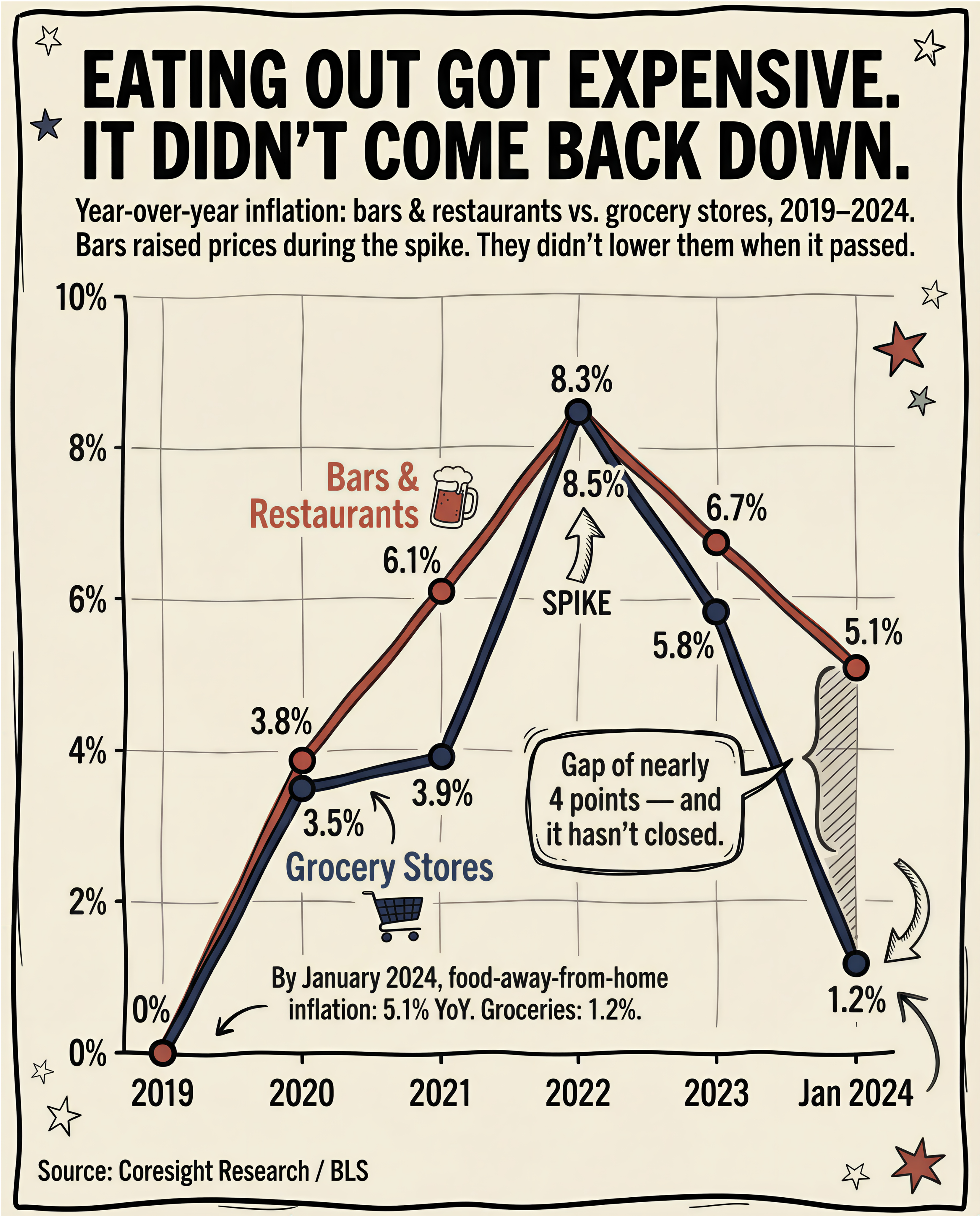
Fewer places. Fractured schedules. Prices that demand justification. These three things did not erode gradually. They collapsed inside of roughly 24 months, and they collapsed together.
You Can’t Be A Half-Regular
This is the context in which regularmaxxing emerged. And the strategy makes sense.
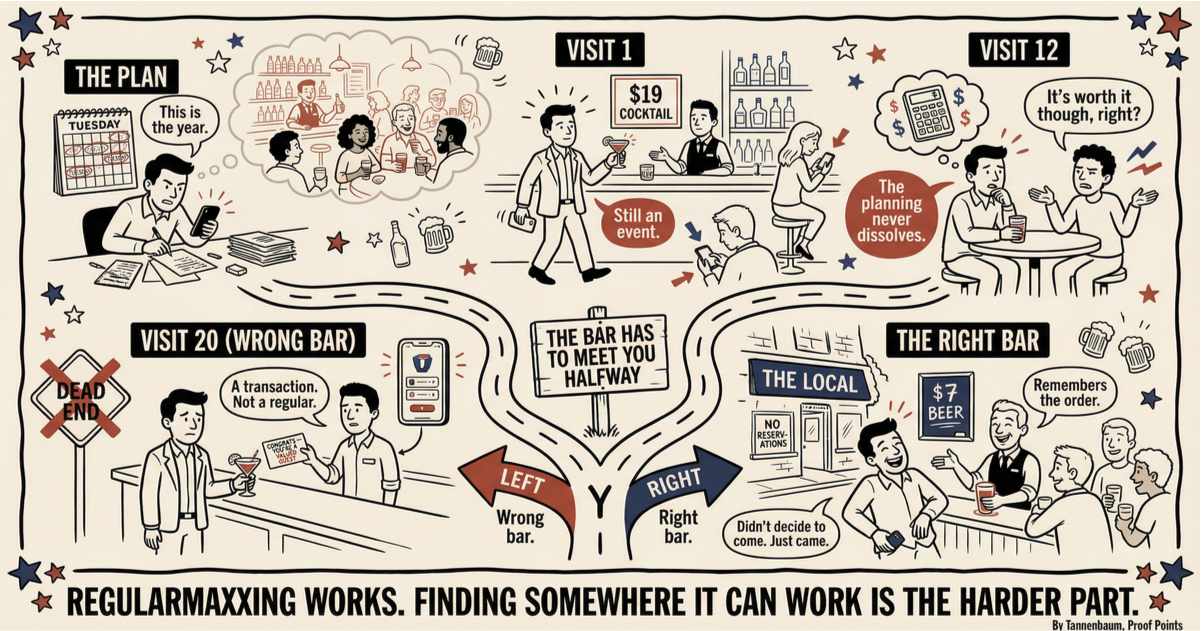
The planning is supposed to be an on-ramp, not a permanent state. Go deliberately a few times and let the place absorb you. At some point you are just there, without having decided to go. The behavior stops requiring effort. The scaffolding falls away. That is when you have actually become a regular.
You can’t do it alone. The bar has to meet you halfway, and most bars right now cannot. Not because the hospitality is bad. Because the industry economics make casual impossible.
The old neighborhood bar worked because showing up often enough created the conditions for more showing up. The bar produced the repetition it depended on. The weekly Thursday crowd became a social anchor, which made Thursday feel like the night to go out, which brought in the Thursday crowd. Happy hour worked the same way. The shared release point produced the occasion, which reinforced the release point as a social ritual.
Regularmaxxing is an attempt to rebuild that loop from scratch, through intention. The question is whether the destination can support it.
If the drinks are $18, every visit stays a decision. The visit never becomes automatic. You can go back fifty times and still be choosing to go rather than just going. The price keeps the friction high enough that the planning never dissolves.
A $7 beer is different. You can be there on a Tuesday with no particular reason. You do not have to explain it to yourself. That is the condition that allows the on-ramp to eventually disappear.
Price alone does not solve it. A $7 beer in a bar where everyone is documenting the night for their Instagram story is still an event. It stops being a casual night at the bar and becomes a content shoot that happens to involve drinking.
The performance pressure that social media introduced does to spontaneity what high prices do to repeatability: it keeps every visit in decision territory. If showing up means being seen, and being seen means being judged, then nothing is ever truly casual. The ambient occasion requires cheap drinks and a room where nobody is performing. Those two things used to come bundled together. They are increasingly hard to find in the same place.
The Loyalty Ouroboros
This is where most of the regularmaxxing coverage misses the point.
The Business Insider piece on the trend quoted loyalty app founders who were excited about formalizing the behavior: rewards programs, recognition technology, systems to track frequency and signal belonging back to the customer. The framing was that becoming a regular is something that can be engineered through the right incentive structure.
It gets the mechanism backwards. A loyalty stamp does not manufacture the feeling of belonging to a place. Belonging accumulates through the weight of low-stakes returns. From going enough times without anyone making it a big deal, including you.
The moment a visit gets rewarded, it stops being ambient and becomes a transaction. The loyalty infrastructure eats the very spontaneity it’s trying to monetize.
The places that will actually absorb Gen Z regulars are not going to win because they built a better app. They will win because they are cheap enough and consistent enough that the planning eventually becomes unnecessary. Because the bartender remembers your drink before you have been coming long enough to expect it. You start recognizing faces without trying to and the price is low enough that showing up requires no more justification than a coffee.
An app cannot make you a regular
The Generation That Inherited the Rubble
The instinct is right. The math is hard. You need a bar that is cheap enough to return to without justification, consistent enough that the same people show up, and unpretentious enough that nobody is performing.
That bar exists. There are just a lot fewer of them than there used to be, and the ones that remain are fighting rent, food costs, and a hospitality culture that has spent a decade rewarding spectacle over repetition.
It is easy to mock regularmaxxing (the name does it no favors). But this is not a Gen Z failure. Their version of Cheers is less a corner bar and more a Discord server that never closes, where the regulars are usernames instead of barstools. It is a Gen Z adaptation to conditions they did not create, in a social landscape that has been quietly making casual human connection structurally harder for two decades.
Regularmaxxing works. Finding somewhere it can work is the harder part.