
Gen Z Optimism Is Directionally Right - and Chronically Early
Confusing direction with timing

Each downcycle, the beverage alcohol industry tends to rediscover the same hopeful narrative: the next generation will reverse the decline. The latest round of Gen Z data gives that argument real support, yet volumes remain under pressure. The gap between those two facts has led to growing confusion about what, exactly, the data is telling us.
According to IWSR’s Bevtrac survey, Gen Z drinking participation has risen meaningfully across major markets. Among legal-drinking-age Gen Z consumers in 15 tracked countries, the share reporting alcohol consumption in the past six months increased from roughly 66% in early 2023 to the low-70s by 2025. The participation gap versus total adults has narrowed to only a few percentage points, the smallest difference ever recorded. IWSR summarized this plainly in its press release, “Gen Z NOT the generation of moderation, survey reveals,” with follow-on coverage in The Spirits Business.
On paper, that looked like a turning point.
At the same time, alcohol volumes remain soft. Global beverage alcohol continues to face pressure from constrained disposable income and a weaker on-premise channel, and U.S. spirits volumes have declined after nearly 30 years of uninterrupted growth. IWSR’s global outlook makes clear that recent declines are being driven by affordability constraints and occasion loss rather than by a collapse in Gen Z demand. VinePair’s summary of the same data points to squeezed budgets and fewer on-trade visits as the primary headwinds, not generational abstinence.
This apparent contradiction has led some observers to conclude that Gen Z behavior is somehow inconsistent or unreliable. A more accurate interpretation is that the industry is confusing direction with timing.
There is a structural lag. Participation measures openness and intent. Volume depends on purchasing power, routine formation, and control over shared occasions.
Once Gen Z drinks, their behavior looks broadly similar to older cohorts. IWSR finds that Gen Z drinkers are more likely than older generations to say they are actively choosing to drink more, and they are more likely to report that their last drinking occasion took place in a bar, restaurant, or club. Nearly half of legal-age Gen Z drinkers report an on-trade last occasion, compared with just over one-third of all adults.
The interest is real. The constraint is structural.
Gen Z remains early in careers, more exposed to economic pressure, and less likely to control the environments where alcohol consumption compounds: households and hosting occasions. Rabobank’s analysis of U.S. Bureau of Labor Statistics data shows that households led by someone under 30 now spend roughly 0.74% of income on alcohol, compared with about 1.1% a decade ago, implying that Gen Z is spending roughly one-third less of their income on alcohol than similarly aged Millennials did.
RBC and IWSR both note that Gen Z’s drinking trajectory was delayed by pandemic-era entry and subsequent inflation, meaning participation is rising before social and economic patterns have fully normalized.
As a result, Gen Z demand tends to surface as episodic engagement rather than a stable base of volume.
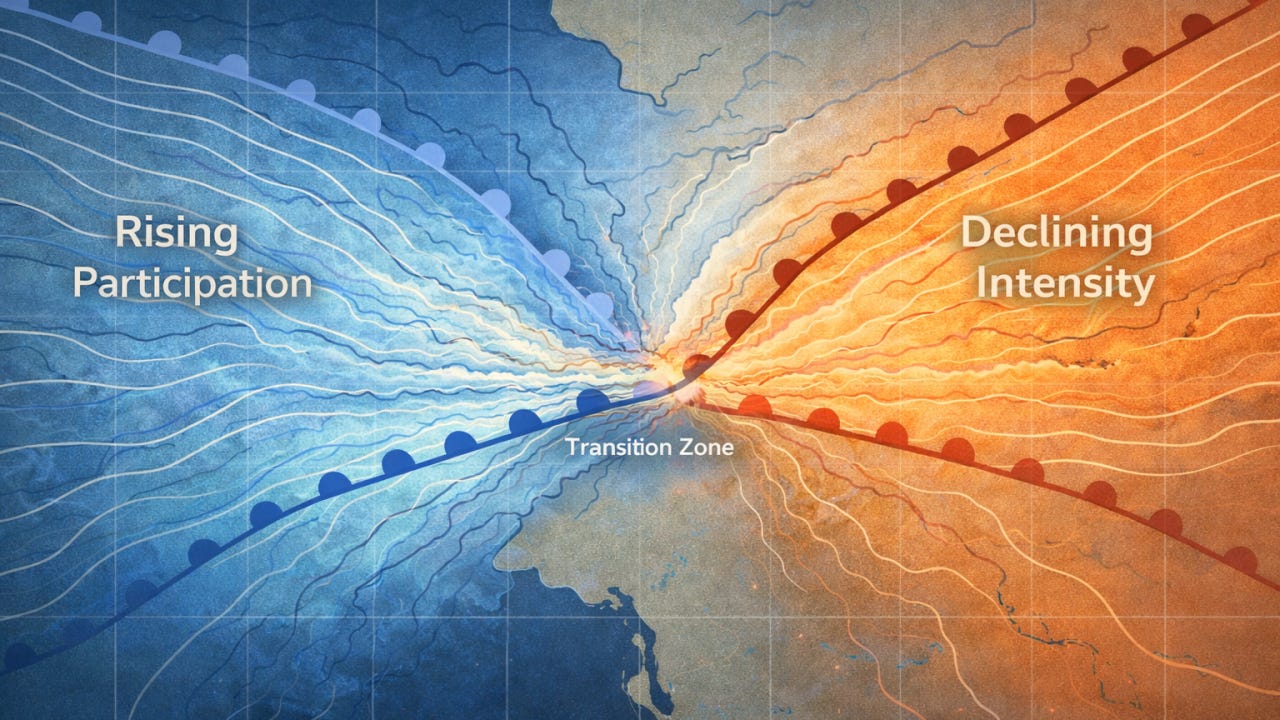
Meanwhile, the more consequential shift is occurring among Millennials. Millennials still account for the largest share of alcohol purchasers, but recent data shows that their intensity is falling. IWSR reports that the number of categories consumed at the last occasion by Millennials across 15 markets declined from an average of 2.8 in Autumn 2023 to 1.8 by Autumn 2025.
In the U.S., the share of Millennials whose most recent drinking occasion was on-premise fell from 41% to 36% over the same period. This is not abstention. It is contraction.
Gen Z shows up in surveys, Millennials show up in depletions
Forecasts have largely identified the right cohort; they have simply been early. Gen Z is re-engaging with alcohol, as participation and on-premise interest continue to rise, but recent sell-side volume cuts and ongoing production pullbacks suggest that interest has not yet converted into durable demand.
At the same time, Millennials, who still account for the majority of alcohol spend, continue to narrow frequency, category breadth, and on-premise occasions, meaning Gen Z gains are still being offset at the system level.
Volume will not recover until these trajectories intersect: when Gen Z’s participation is matched by greater economic power and routine-setting influence, and when Millennial contraction stabilizes rather than deepens. That transition is coming, but it will unfold on the timeline of income growth, habit formation, and life-stage progression - not on the timeline implied by participation headlines alone.