
Maureen at Donohue’s

Everybody gets to be the main character of their own life. That’s the whole premise of the phrase as people actually use it now, a way of saying you’re carrying yourself like the camera’s on you, narrating a coffee order or a walk down the street as if it were a scene worthy of capture and distribution. It’s a nice idea, and it’s almost always true in the sense people currently mean it. It is almost never true in the older, narrower sense the phrase actually comes from.
A main character, in that original sense, is the person a story cannot run without. Take them out and there’s no story left, just a setting where one used to happen. Most people, including most people who would correctly say they have main character energy, are not that. They’re memorable. They may even be central to a few scenes. But they don’t drive the plot.
Mark tends bar at my neighborhood go-to restaurant, the Whitlock. He knows my order, my name, my daughter’s name. He’s my bartender, and a good one at that. None of that makes him a main character. If anything, his preternatural awareness of when to lean into a conversation and when to gracefully move down the bar is exactly what a good supporting player does. He’s not the lynchpin. While his absence would be felt, the Whitlock will still be the Whitlock without Mark behind the bar. I don’t think he’d argue that.
What’s actually rare isn’t being known, or even being loved. It’s being the one person a place cannot survive without, who defines the place rather than staffs it. A bar can have several bartenders the regulars genuinely love and still only ever have one or two who are, in this specific sense, irreplaceable.
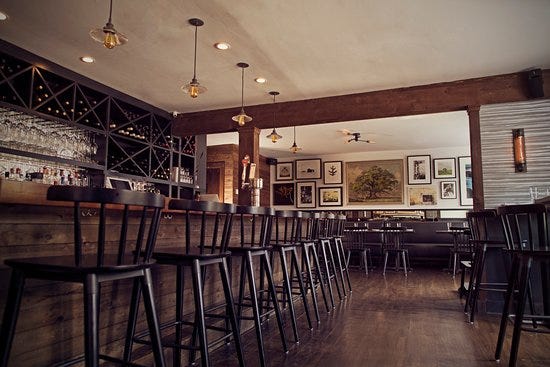
Chaucer’s Canterbury Tales opens at a real inn, the Tabard, where a chance gathering of strangers turns into the entire frame of the book because the innkeeper proposes a storytelling contest, agrees to judge it, and decides to come along. Chaucer calls him simply “the Host” for most of the prologue. We only learn his name, Harry Bailly, much later, almost as an afterthought.
Bailly turns out to be real, incidentally: town records put a Henry Bailly in Southwark as the local tax collector in the years before the Peasants’ Revolt, the same neighborhood, the same period. Chaucer didn’t invent the idea. He watched a man already doing it and wrote it down.
Six hundred years later, the writers behind Cheers did the same thing with a little less ceremony. The exterior shot is a real Boston bar, the Bull & Finch, and the bartenders the show’s creators spent time inform who Sam Malone actually is underneath the baseball backstory. Even Rick’s café in Casablanca has a paper trail, a Manhattan nightclub impresario named Billy Rose fused with a Paris bar the screenwriter actually sat in before the war. Neither was invented from nothing.
Memorable bartenders, it should be said, aren’t rare in fiction. Every decade produces a few vivid, quotable ones. Moe Szyslak is one, a real Jersey City bar owner named Louis Deutsch folded into a cartoon, famous for exactly nothing except being unforgettable for the five minutes he’s on screen. What’s rare is a bartender the story can’t survive without. Sam Malone is that. Take him out of Cheers and there’s no show left.
Donohue’s on Lexington Avenue had one. Maureen Donohue-Peters. Her restaurant closed a few weeks ago, and it would have been easy to tell the version of this story that everyone tells about New York these days: rent went up, another institution dies, somebody mourns a checkerboard tablecloth in a comment section of a paywalled article. That’s not what happened.
Defying expectations, her landlord, David Berger, offered to lower the rent when she told him she was leaving. She’s going anyway, after seventy-six years, not because the city pushed her out but because she’s ready for what comes next. Not retirement, but a more deliberately paced life in Westhampton Beach, where her other restaurant, Donohue’s East, already is.
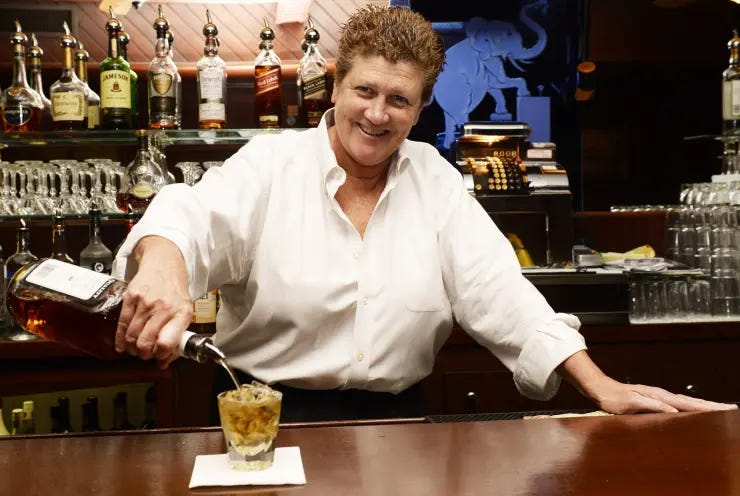
A regular named Robert Ellsworth ate at Donohue’s seven nights a week for decades, an Asian art collector worth nearly two hundred million dollars who never once learned her last name. When he died in 2014, his will left her fifty thousand dollars, and rather than guess at a surname he’d never asked for, his lawyers just wrote down how he knew her. His will calls her Maureen at Donohue’s. Berger put it more plainly when reporters called him this week: the first thing people ask is whether Maureen will be there, “because she is the restaurant.”
This makes the actual anomaly at Donohue’s far more interesting to me than the rent narrative. The standard story needs a villain, a landlord, a crime wave, a lease nobody could afford. This one doesn’t have one. Berger wanted her to stay. The neighborhood wanted her to stay. By her own account, she still loves the work. None of that mattered, because a restaurant that runs on one irreplaceable person doesn’t get a vote when that person decides the chapter is finished.
It doesn’t usually end this gently. Toots Shor’s restaurant collapsed under tax debt in 1971, and when his name was later sold off and licensed to a small chain of bars that had nothing to do with him, nobody was fooled. The sportswriter Red Smith wrote that there was never a gathering place like it and never would be again. Decades later, in a brownstone on Restaurant Row that had stood since 1925, Barbetta closed within six weeks of its owner’s death. Laura Maioglio had run the place since 1962, a hundred and twenty years of family ownership, and there was no one left who was Barbetta the way she had been.
Once in a while, someone tries to rescue the person instead of the building. A bar called Lucy’s, named for the woman who ran it, got evicted in 2024. It came back the following spring because someone else paid to bring it back, specifically so Lucy, eighty-four years old, would have somewhere to keep tending it.
Elaine Kaufman ran a similar experiment, in reverse. Her longtime manager inherited everything when Kaufman died, the lease, the staff, the regulars, the name on the awning, and closed it five months later anyway, because, as she put it, there was no Elaine’s without Elaine. And there’s no Donohue’s without Maureen.