
Summer’s Occasion Stack Is Real
Here’s What It Rewards

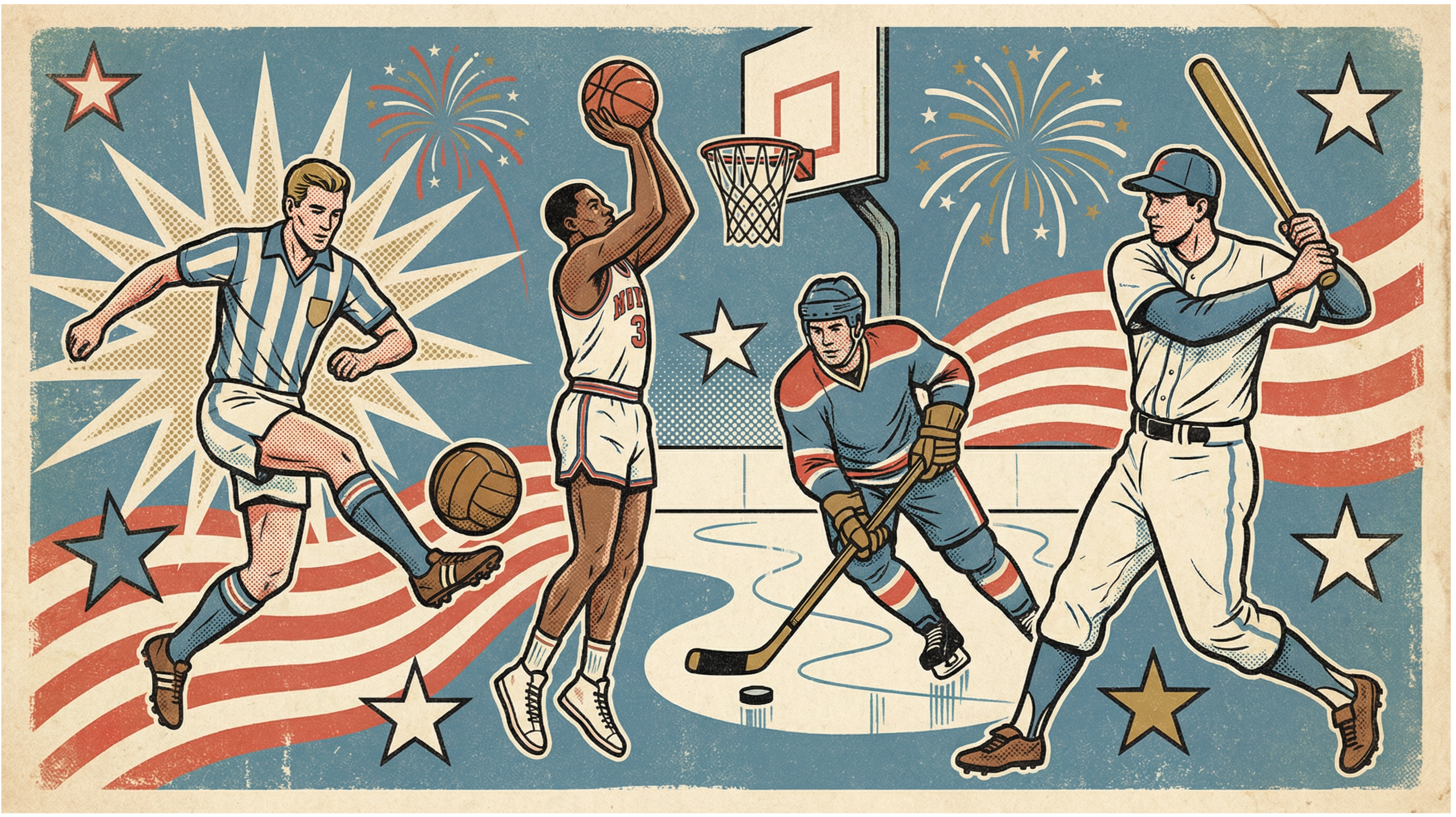
Summer 2026 is unusually dense. Profoundly dense.
The World Cup: summer 2026 across 16 host cities in the U.S., Canada, and Mexico, with knockout rounds concentrated in major U.S. markets.
NBA Finals wrapping early June.
Stanley Cup Finals finishing late June.
MLB All-Star Game mid-July in Philadelphia.
And the wildcard: America 250, the yearlong celebration of the United States’ 250th anniversary, peaking July 4, 2026 with major events across every city. Whether this translates to drinking occasions or patriotic family programming remains unclear, but the calendar density is undeniable.
This isn’t just a busy summer. It’s a combination that won’t repeat in any current planner’s career. The U.S. last hosted a World Cup in 1994. The next major American anniversary is the 275th in 2051 or the 300th in 2076. Summer 2026 puts both in the same six-week window.
And what makes these moments worth understanding is what 2025 data already showed about which occasions still drive consumption, and what brands they reward.
Permission-Granting Occasions Lower the Social Cost of Showing Up
Permission-granting occasions are events that provide social justification for participation. They lower the friction of showing up, spending, and consuming because the cultural significance of the moment makes those behaviors feel appropriate rather than indulgent.
The difference between a World Cup semifinal viewing party and a normal Thursday isn’t just attendance. It’s social permission. Someone who hasn’t been to a sports bar in months will show up for a U.S. knockout match, not because they suddenly want to drink more, but because the event makes going out feel worth it.
NIQ/CGA analysis of 2025 showed on-premise facing pressure but with spending concentrating on high-value occasions. The calendar compression matters: when visits decline but basket size increases on big days, it means consumers are reserving participation for moments that feel justified.
North American hosting amplifies this effect. World Cup matches happen during prime consumption hours for U.S. audiences, and multiple host cities create regional event economies that drive both on-premise and off-premise sales simultaneously.
Summer will provide that justification at unusual scale.
The Data from 2025 Shows What These Occasions Reward
2025 category performance tells you exactly what large, permission-granting occasions favor:
Beer
Down modestly in 2025, with performance comparable to spirits and clearly ahead of wine. According to NielsenIQ’s mid-year 2025 report, total beverage alcohol sales were down 3% year-over-year for the 26 weeks ending July 5, 2025.
Beer’s advantage isn’t price or ABV. It’s role clarity. It functions as a default, doesn’t demand attention, doesn’t require signaling. When occasions are larger but socially lighter (watch parties, cookouts, public viewing events), beer fits without friction.
RTDs
Up low single digits in value in 2025 in an environment where nearly everything else in spirits contracted. NIQ data showed RTDs up 1.7% in dollars but down 3.2% in volume for the first half of 2025. But category performance varies significantly. Vodka-based RTDs continue to gain share, while some tequila-based entrants struggle. High Noon showed signs of plateauing in some panels after years of growth, suggesting even category leaders face saturation in baseline occasions.
RTDs succeed in specific contexts because they’re occasion-shaped rather than venue-shaped. They work across tailgates, backyards, parking lots, all the temporary spaces where summer’s big gatherings actually happen. They’re not replacing on-premise. They’re competing with the friction of finding one.
Tequila (Brand Story, Not Category Story)
Tequila as a category held up modestly better than other full-strength spirits in 2025, serving as a relative bright spot. But the real story is brand-level. Don Julio was the only major full-strength spirits brand in the top 25 to post volume growth in 2025, up 16% to just under 4 million cases.
Don Julio’s success reflects lower signaling cost relative to premium whiskey. A $40 bottle of Don Julio at a casual World Cup watch party doesn’t demand the occasion formality that $40 bourbon does. It reads as participation, not performance. That’s a brand positioning achievement, not a category-wide advantage.
Large summer occasions reward products that support the moment without trying to own it.
Moderation Trends Reinforce the Occasion Thesis
Broader moderation trends don’t undermine this argument. It reinforces it.
As consumers become more selective about when and why they drink, the occasions that still justify alcohol consumption become more valuable. Baseline frequency declined through 2025, but high-stakes occasions maintained spending intensity.
Summer 2026’s event concentration matters precisely because everyday consumption is falling. The occasions that clear the bar for participation will capture disproportionate share.
Gen Z Isn’t a “Less Drinking” Problem. It’s a “Less Tolerance for Weak Occasions” Problem
I’ve written about this ad nauseam, but it’s worth reviewing. The narrative that Gen Z doesn’t drink has been convenient for explaining declines, but it misses what’s actually happening. They drink differently, and they’re far more selective about when occasions justify showing up.
On-premise research shows Gen Z as significantly more experimental and variety-seeking than Millennials or Gen X. CGA by NIQ data indicates they’re substantially more likely to try new cocktail styles when they go out, and they average more category variety per visit.
But they’re also substantially less likely to show up for a random weeknight compared to their participation in event-driven occasions.
Consumer intention data suggests roughly one in four consumers plan to increase on-premise spend in 2026, with that number higher among younger cohorts. That increase won’t happen uniformly. It’ll concentrate on moments that feel culturally significant.
World Cup matches in North American cities, America 250 celebrations, major holiday weekends: these clear that bar. Random Thursdays don’t.
The America 250 Wildcard
America 250 is the great unknown.
The 250th anniversary of the Declaration of Independence runs throughout 2026, peaking July 4 with events in every major city. The Times Square Ball will drop twice in 2026: New Year’s Eve and July 3, the first non-New Year’s drop in history. Plans under discussion include an International Fleet Review in New York Harbor and ceremonial events in Philadelphia.
This could be massive for alcohol. Patriotic celebrations, city-wide parties, justified day-drinking, permission to gather and commemorate.
Or it could skew family-friendly, civic-minded, and sober. Parades and educational programming instead of bars and cookouts.
The difference matters. If America 250 activates as drinking occasions (think July 4th weekend times ten), it compounds an already-dense summer calendar. If it doesn’t, the World Cup still carries the load, but without the extra domestic amplification.
Either way, brands can’t ignore it. But they also can’t assume it converts.
Distribution at the Point of Gathering Wins
As occasions become more event-dependent, proximity to the moment of decision matters more.
Holiday weekend patterns in 2025 showed beer in convenience stores materially outperforming the same category in grocery, with the gap widest on major summer weekends like July 4th, Memorial Day, and Labor Day. NIQ channel data consistently shows convenience store strength during high-traffic holiday periods.
When someone texts “meet for the game in an hour,” the alcohol purchase happens three blocks from the destination. Not during a planned grocery run two days earlier.
Summer’s mega-occasions will be both scheduled (World Cup matches, America 250 events) and spontaneous (last-minute watch parties, impromptu gatherings). C-store and small-format positioning near venues, sports bars, and residential clusters captures both patterns.
You’re not competing with other brands. You’re competing with the friction between the group text and the first drink.
On-Premise Gets Temporary Participant Density Back
On-premise value performance in 2025 showed modest gains in bars and restaurants while off-premise channels faced pressure. According to CGA by NIQ’s On Premise Measurement data through September 2025, spirits sales by value in U.S. bars and restaurants grew 0.8%, and spirits captured 46.9% of on-premise alcohol sales by value. Bars and restaurants serve as the primary trial environment for new cocktails and spirits brands.
But the on-premise recovery isn’t uniform. It’s event-driven.
Third places matter more when specific occasions temporarily restore the participant concentration and social permission that makes going out feel justified.
World Cup knockout matches, and potentially America 250 celebrations, will provide that at scale. Bars positioned as event destinations (pre-announced viewing schedules, limited-time serves, simple bundles that reduce choice friction) will see traffic they haven’t seen in years.
Venues waiting for “normal nights” to return will keep waiting.
Brands Are Learning to Support Moments, Not Own Them
The shift happening across the industry is away from trying to create demand and toward positioning inside moments that already generate it.
Major beverage companies are expected to activate heavily around World Cup host cities and America 250 events throughout summer 2026. The strategic approach favors supporting existing cultural moments over attempting to manufacture new occasions.
What This Means, and What to Do About It
For Suppliers:
Lock distribution around key event windows. Priority placement in c-stores and small format near host cities, sports bars, and high-density residential areas during World Cup and major America 250 events.
Prioritize formats that travel to watch parties. Single-serves, 4- and 6-packs, RTDs, shareable tequila SKUs. Make it easy for people to grab and go.
Don’t demand ceremony. Familiar serves, default status, low friction. If your brand requires explanation or ritual, you’re competing with beer and RTDs that don’t.
Have an America 250 point of view. Decide early whether you’re activating patriotic celebrations or sitting it out. Don’t get caught mid-summer without a plan.
For Operators:
Build event destination positioning early. Pre-announce World Cup viewing schedules and America 250 programming. Simple bundles tied to match times (for example: “Match Day Special” with 2 signature cocktails plus 1 appetizer for $25, pre-batched and served within 5 minutes). Make it obvious you’re the place to watch.
Reduce choice friction. Event-specific serves, limited menus during matches, pre-batched options. When crowds are dense and occasions are time-bound, speed matters more than variety.
Test America 250 positioning cautiously. If July 4 weekend shows strong engagement with patriotic themes, double down for the back half of summer. If it skews family-friendly, pivot back to pure sports focus.
What Brands Should Be Measuring (and What “Good” Looks Like)
The question isn’t just whether summer drives volume. It’s whether the gains hold.
What to Watch:
Velocity in Q3 vs Q4. Does summer create momentum or just a spike that collapses in September? A Q3 velocity improvement that holds at least 60% into Q4 suggests sustained occasion shift. Anything below 40% retention indicates temporary boost only.
Occasion frequency vs basket size. Are people going out more often, or just spending more on big days? If basket size increases 15%+ on event days but visit frequency stays flat, the occasion thesis holds.
Trial-to-repeat rates. Did summer recruit new consumers or just activate existing ones? Recent holiday season data shows roughly 18% of shoppers bought brands they first tried on-premise, suggesting trial converts at roughly 1-in-5 rates when positioned correctly. Anything above 15% trial-to-purchase conversion justifies the investment.
America 250 conversion. Track July 4 weekend 2026 vs July 4 weekend 2025. If occasion spending jumps 20%+, America 250 is activating as drinking occasions. If it’s flat or down, it’s not.
If summer occasions work, they work by temporarily restoring participant concentration to social drinking. If that concentration collapses in fall, we’re back to fragmented, conditional occasions where every drink feels negotiated.
But if summer resets expectations (if it reminds people that going out for meaningful events can feel worth it again) then the back half of 2026 matters beyond immediate volume.
The Underlying Reality
High Noon showed signs of plateauing in 2025 after years of growth. That tells you something about baseline occasion frequency when the calendar’s normal.
Don Julio growing 16% in 2025 while the rest of spirits contracted tells you something else: when occasions feel significant enough, people still trade up. But the occasion has to justify it first.
Summer 2026 will provide that justification at unusual calendar concentration. World Cup in North America for the first time since 1994, plus America 250, the biggest U.S. patriotic milestone until 2051.
This combination won’t repeat in any current industry planner’s career.
The Takeaway
The industry has a unique challenge: How does alcohol can fit inside the occasions that still feel worth showing up for?
Summer 2026 stacks more of those occasions than any period in recent memory. They’re large-scale, culturally sanctioned, and they’ll provide the social permission that makes participation feel justified.
The brands that win will be the ones positioned to support these moments without trying to own them, because the moments are already doing the work.
Stop trying to create the night. Just make it easier for people to say yes when the moment shows up.
This summer, the moments are showing up at scale. Don’t miss the window.