
The Consumer Is a Context
The alcohol industry has been targeting a person who only exists in aggregate.

It’s December 1975 and a young assistant professor of marketing at Temple University has just published an eight-page paper in the Journal of Consumer Research. Russell Belk’s argument was simple enough to fit in a single sentence: situational variables (where you are, who you’re with, what time it is, your mood walking in the door, which Belk called an antecedent state) predict consumer behavior at least as well as individual traits like personality or demographics.

The field agreed. The paper accumulated nearly 1,700 academic citations. It became a standard chapter in consumer behavior textbooks. The same issue of JCR that published it ran peer commentary in response, an editorial signal that the editors considered the argument worth debating immediately.
Marketing departments hired people with degrees who had read this paper in their sophomore year.
And then the industry went right back to slicing its customers by age, income, and gender.
On a Friday night in January, a 42-year-old man in Austin pays $70 for a bottle of tequila. On Tuesday, the same man buys a $12 four-pack of RTD canned cocktails at a convenience store on his way home from work.
The industry looked at that behavior pattern and called it a barbell economy in response to income pressure. A consumer abandoning the premium tier.
This is a categorization error.
The man did not trade down. He walked into two different situations and made two different rational decisions. On Friday, he was hosting. The bottle was visible on the counter. It communicated something: about him, about the evening, about the people he was with. On Tuesday, he was tired. He wanted something cold that required no additional meaning. The RTD solved a completely different problem.
Same person. Different context.
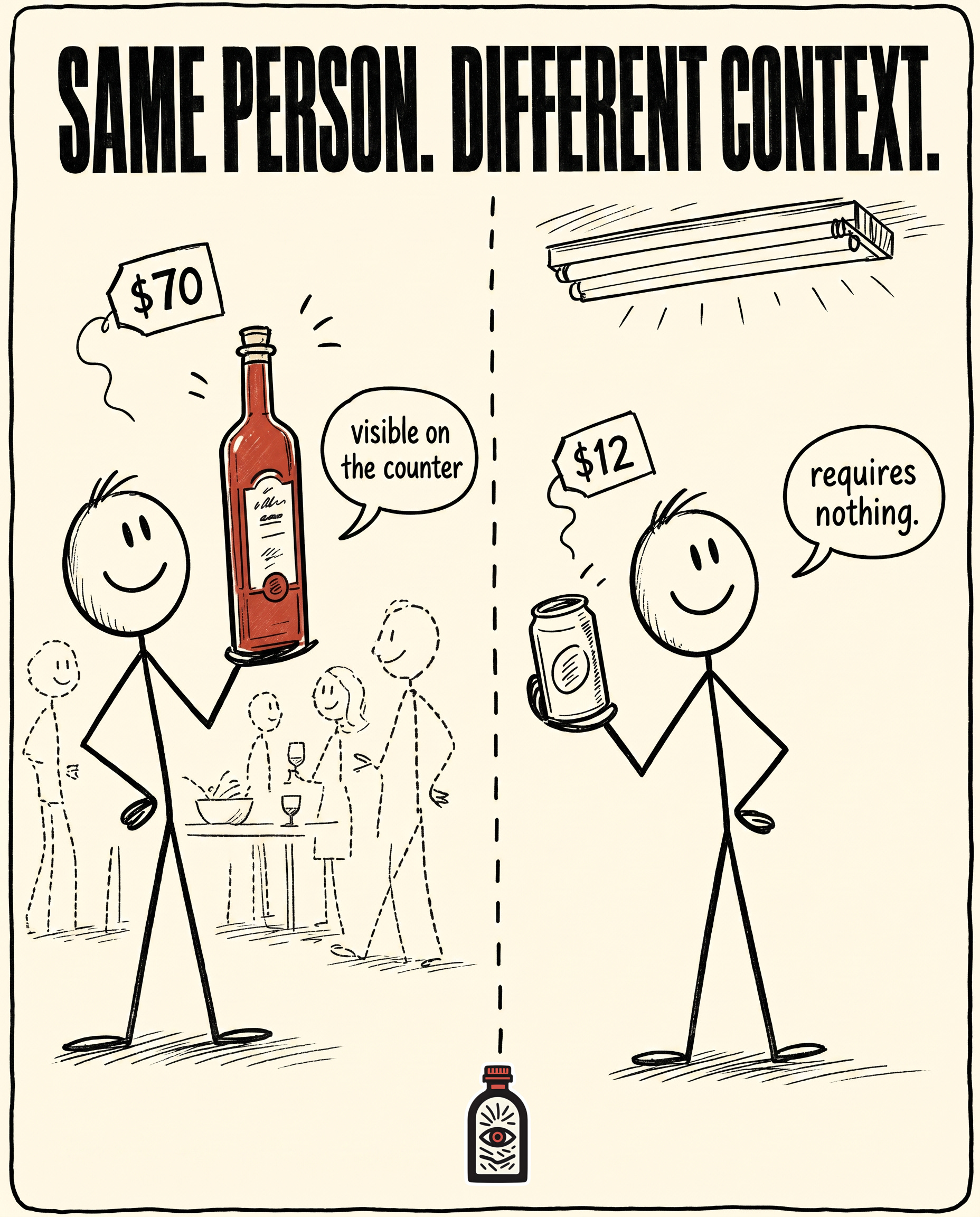
NielsenIQ’s 2024 analysis of the RTD market found that 14 percent of U.S. beverage alcohol households buy beer, wine, spirits, and RTDs simultaneously, across all four categories in the same measurement period. Those households account for 29 percent of total category volume. The consumer who buys across the entire price spectrum is not the exception. He is the category’s most valuable customer.
When consumers substitute away from something to drink an RTD, the most displaced drink is beer. NIQ data suggests that when consumers substitute toward RTDs, the displacement often comes from beer and other low‑ceremony options, not from ultra‑premium spirits. They are not taking the $70 bottle’s occasion. NIQ data makes the consumption logic visible: 70 percent of RTDs are consumed the same day they’re purchased. That’s not a considered buy. It’s a context-driven one.
NielsenIQ’s on-premise measurement data from July 2025 makes the split explicit. Ultra-premium spirits gained 2.2 percentage points of share in nightclubs in 2024. The same period saw RTD volume growing in off-premise retail. The consumer buying ultra-premium tequila in a nightclub on Friday is the same person buying the $12 can at a convenience store on Tuesday, allocating spend based on context.
This is what Belk was describing in 1975. The marketing industry acknowledged him in syllabi and ignored him in boardrooms. The insight was available. The data infrastructure to act on it was not.
Demographic data was what syndicated panels, Nielsen household tracking, and survey segmentation could deliver at scale. Occasion-level data was expensive, proprietary, and operationally difficult. So the industry optimized for what it could measure. For decades, the most scalable syndicated systems told you who the consumer was, not which specific situation they were in.
That has changed. The occasion-level data now exists. And what it shows is not a barbell. It is a single consumer navigating multiple occasion states in the same week, with different identities activated in each one.
The psychologist Hazel Markus, writing in 1987, called this the working self-concept. The self is not a fixed structure carried uniformly across situations. At any given moment, only a subset of self-knowledge is active, shaped by the social environment, the physical setting, the stakes of the moment. When you are hosting a dinner, your social-host identity is active. When you are alone on a Tuesday, something else is.
Richard Thaler’s mental accounting work explains the financial mechanics: consumers assign different dollars to different mental accounts, each with its own logic. The $70 from the “special occasion” account and the $12 from the “weeknight” account are not the same dollar being spent twice. They are two different purchase decisions made by two different active selves, neither of which maps cleanly to the man’s age or income bracket.
The industry has a version of this framework. It’s called occasion-based marketing, and I’ve been making the case for it in Proof Points for a while now: the more useful unit of analysis is not who the consumer is but what moment they’re in. The argument hasn’t changed. What Belk adds is the rationale underneath it: an explanation for why the same person runs different decision logic in different occasions, which is the part the standard occasion model tends to treat as a given rather than a finding.
The standard occasion framework describes demand correctly. It names the moments, sizes them, and maps which products tend to win them. What it doesn’t account for is that the consumer arriving at each moment is not the same person carrying the same preferences through different situations. They are running a different working self-concept, drawing from a different mental account, operating under different social stakes. That’s why demographic data fails to predict cross-occasion behavior: demographics describe the person, not the configuration of variables that determines how that person will act in a specific moment.
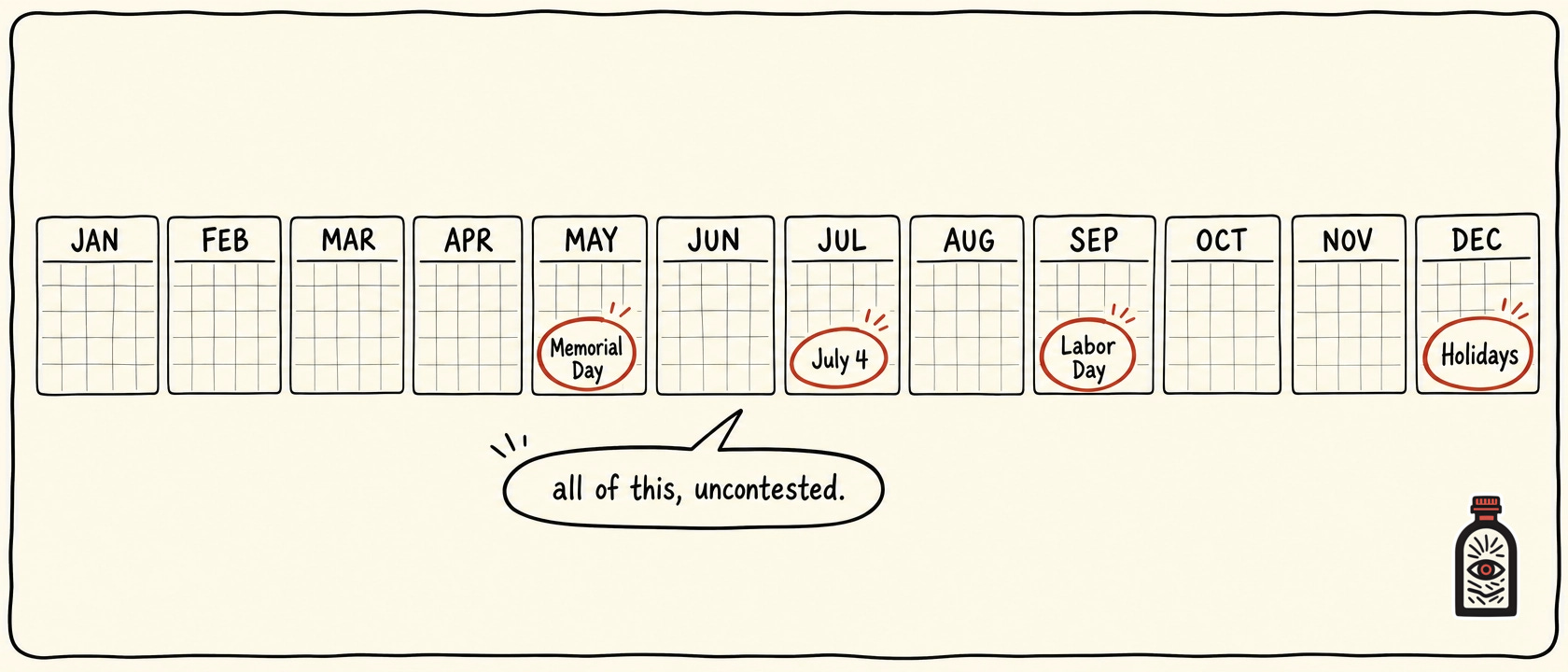
Here’s the sharper version of the problem. Even the brands that have adopted occasion thinking tend to operationalize it through a handful of key merchandising windows, like Memorial Day, July 4, Labor Day, and the holidays. That is the industry’s full occasion imagination for most of the calendar year. It leaves uncontested an enormous range of moments where people are already gathering, already drinking, already looking for something to reach for. Nowruz. Purim. Back to school and graduation weekends in college towns. Formula 1 Sunday mornings in U.S. cities. Watch parties organized around reality television.
None of these require a category-specific product. They require a brand that recognized the occasion existed.
The tequila category has produced the cleanest version of this data. Tequila grew from roughly $5 billion in U.S. retail sales in 2019 to over $13 billion in 2023, driven by the super-premium tier. By 2024–2025, the super‑premium tequila tier had begun to soften in retail scans, prompting a narrative that “the tequila boom is over.”
The actual picture is more specific. Tequila’s on-premise share kept growing. RTD tequila posted double‑digit year‑over‑year gains. Diageo’s tequila net sales around 20 percent in the six months ending December 2024. The consumer did not abandon tequila. They redistributed their tequila spending across occasions. The $70 bottle moved to the situations that justify it. The $12 can filled the ones that don’t.
Diageo appears to have understood this. When they launched Casamigos Margaritas RTDs in June 2025 (canned, non-carbonated, made with Casamigos blanco, priced around $14 for a four-pack), the stated framing was explicitly occasion-based. The RTD delivers the Casamigos experience for situations where mixing a cocktail is a barrier. It’s the same brand identity activated in a different context.
Brown-Forman’s experience with Jack Daniel’s RTDs illustrates what happens when that distinction gets blurred. Jack Daniel’s RTDs have softened while the core whiskey continues to grow, suggesting the RTDs were cannibalizing rather than expanding the brand’s occasions.
The question was never whether to launch an RTD. The question was which occasion the RTD solves for, and whether that occasion is actually different from the bottle’s occasion.
Wine didn’t simply lose drinkers between 2022 and 2024. It lost occasions. Wine's most dependable casual occasion, the evening wind-down, has lost significant share over the past two years, per IWSR data. The consumer who used to open a bottle at the end of a workday started reaching for something else: a hard seltzer, an RTD cocktail, a non-alcoholic option, sometimes nothing at all. The bottle of wine still exists in their life. The occasion that used to reliably call for it does not.
Demographics cannot explain this. The wine drinker did not age out of the category or hit an income wall. Their Tuesday evening changed. The structure of the moment shifted: less decompression ritual, more fragmented scrolling, less of the ambient permission that made opening a bottle feel automatic. Context changed. Behavior followed.
This is where the industry’s demographic playbook fails in a way that is genuinely hard to recover from. A brand can respond to a demographic shift: adjust positioning, find a new audience, reformulate for a younger palate. A brand cannot easily respond to an occasion shift it hasn’t noticed because it was never measuring occasions in the first place.
Demographics are not useless. They predict category preference reasonably well. A 55-year-old Boomer and a 24-year-old Gen Z consumer are likely to reach for different products given identical situations. But demographics do not predict purchase decisions within categories, across price tiers, or across occasions. Context does that.
IWSR’s 2025 Global Trends Report puts it in the industry’s own language: premiumization is no longer linear, with growth increasingly driven by ‘occasion relevance’ rather than only by status signaling. That’s the research apparatus of beverage alcohol arriving, fifty years late, at Belk’s conclusion.
The more precise version of the argument: demographics tell you what someone might want. Context tells you what they will do. A brand strategy built only on the former is targeting a consumer who exists in aggregate data and nowhere else.
Belk saw this in 1975 from a Temple University office with access to none of the data that now confirms it. The industry had fifty years and a textbook chapter. What it lacked was the measurement infrastructure to act on the insight, and, maybe, the willingness to rebuild the strategic muscle memory that had been running on demographic logic since before anyone in those boardrooms was born.