
The Hardest Bar in America
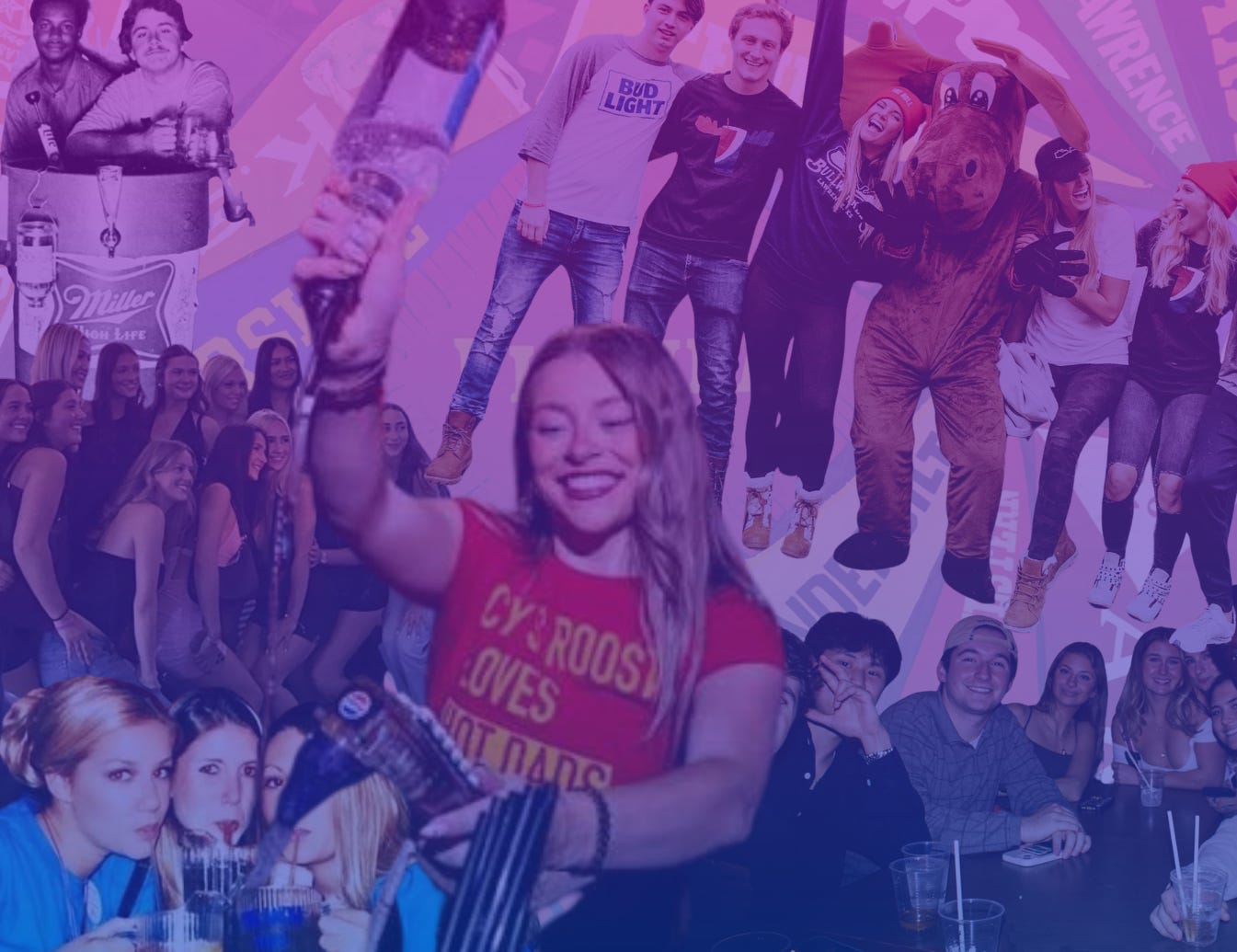
Stand in a bar tonight, around ten, when the room has filled but before it gets loud. Look at the regulars. The couple who orders without looking at the menu. The guy who tips like he has a crush on the bartender. And maybe he does.
In three years, every one of them will be gone. Not most. All.
The staff goes too. The bartender who knows every regular’s drink, the bar-back who turned out to be the best hire you ever made. Eighteen months, give or take, and you are training their replacements. Maybe a general manager continues on. Maybe.
The reputation survives. It transmits through older siblings and orientation week, describing a place they’ve yet to enter, built by a staff no longer employed here. There is no grace period. A crowd shows up the first Thursday of September holding an expectation earned years ago, and you have to live up to it, with a bartender who started six weeks back.
Let’s be honest about this bar’s prospects. Primed for a solid decade? Or is it a bar you would describe, if a friend called about buying it, as a problem? It reads as a disaster.
It is also a description of one of the healthiest categories of bar in America, and some of the spots it describes have been the best bar on campus for decades.
Wednesday night I was in a car in New Orleans headed uptown to The Boot, which sits at the edge of Tulane, has served that campus for decades, and is a LineLeap partner. Halfway there, someone said the obvious thing.
They’re closed.
Of course they were. It was July. Nobody was on campus, and there was no reason on earth for that bar to be open. The closed door was not a sign of trouble but a sign that the operation understands its own business perfectly.
Bars do not close for July. Restaurants do not close for July. Hotels, breweries, taprooms, none of them go dark for a season because the customers are elsewhere. The college bar runs on an academic calendar rather than a city’s, and that alone separates it from every other venue category in the country.
I spent last week at Tales of the Cocktail. Craft bars, well represented. Dives, hotel programs, restaurants, neighborhood joints, all present and accounted for. College bars were not in the conversation. Not criticized, not defended. Absent.
The economics explain most of it, and to be fair, they explain it well. A cocktail built to the standard being discussed at Tales costs what it costs. Time, technique, ingredients, a bartender with the training to execute it consistently at ten o'clock on a Saturday. That drink lands somewhere north of fifteen dollars in most American cities, and it should. The people making it have spent years learning how.
A college bar operates under a ceiling set by what a twenty-two-year-old can spend on Thursday and still go out Saturday. That is not a preference or positioning choice. It’s math. You can put a fifteen-dollar cocktail on the menu, and some do, but you cannot build a business around it and still have a college bar.
So the craft conversation and the college bar have little to say to each other about drinks. I am not going to pretend a spec-driven program is secretly the answer for a room holding four hundred people on a Thursday.
But drinks are not the only thing an industry knows how to talk about.
Total customer replacement every three or four years. The entire book of business, turning over, continuously, forever. Staff replacement every eighteen months, because the staff comes from the same population as the customers. Juniors become seniors and seniors leave.
A reputation that persists without most of the people who built it. The name gets strangers through the door on the strength of what somebody’s older sister said. Then it has to be true that night, executed by a crew that mostly was not there the last time it was earned.
Any operator in another segment facing one of these would call it a crisis. Facing all three, consistently and permanently, they would sell the building.
But the good college bars just do it. They open in August, train the new crop, pack the house, hold the standard, and stay the best bar in town while the entire campus rotates beneath them. Some have been doing it since before their current customers were born.
That is not luck, and it is not the RTDs being cold. That is an operating system.
My job at LineLeap gives me a view into how this happens. Training built on the assumption that the trainer leaves. Standards written to transmit in days rather than months. Service design that survives volume without collapsing.
These operators worked it out over years, sometimes decades without trade coverage and conference panels. They did it without anyone from the broader industry asking how they did it, in a segment the rest of hospitality regards, when it regards it at all, as the place where people drink badly before they learn to drink well. That’s a shame.
Tales, Bar Convent, any conference with a stage should put college bar operators on it. Not a novelty panel about the youth market. An operations and training track, taught by the people who solved the hardest continuity problem in American hospitality because they had no choice.
The craft world spent twenty-five years professionalizing technique and did a remarkable job. It has spent far less time professionalizing the transmission of technique through an organization that turns over completely and repeatedly.
It runs both ways. The craft world could take batching and speed under load from them. The college bar could take a two-ingredient house drink made the same way every time by a nineteen-year-old with six weeks in. Their worlds are not as mutually exclusive as either side believes.
For a great many Americans, the college bar is the first bar. Not the first place they drank. The first place they drank in public, among strangers, with a bartender and a tab and a set of norms they had to learn by watching. It’s where a person finds out what a bar is for. Whether it is a place you go to get obliterated or a place you go to see people. Whether the bartender is a vending machine or someone who might remember you and, heaven forbid, educate you.
The industry has spent years in an increasingly frantic conversation about whether young people will show up. Meanwhile the venue category built entirely around young people showing up is not a part of the conversation.
I do not think that is snobbery. The institutions of this industry were built around a different kind of bar, and the college bar does not fit the shape of them: wrong price point, wrong season, wrong reputation, wrong everything except the part where it works.
The Boot opens when Tulane does. The room fills. Nobody in it will know that an industry spent a week two miles away discussing the future of drinking without mentioning them, and it will not matter, because the operators have a more pressing problem: a few thousand people are about to walk in for the first and need a reason to come back.
They will have solved it by September. They solve it every year.