
The On-Premise Split
Why College Bars Still Operate on a Different Alcohol Economy

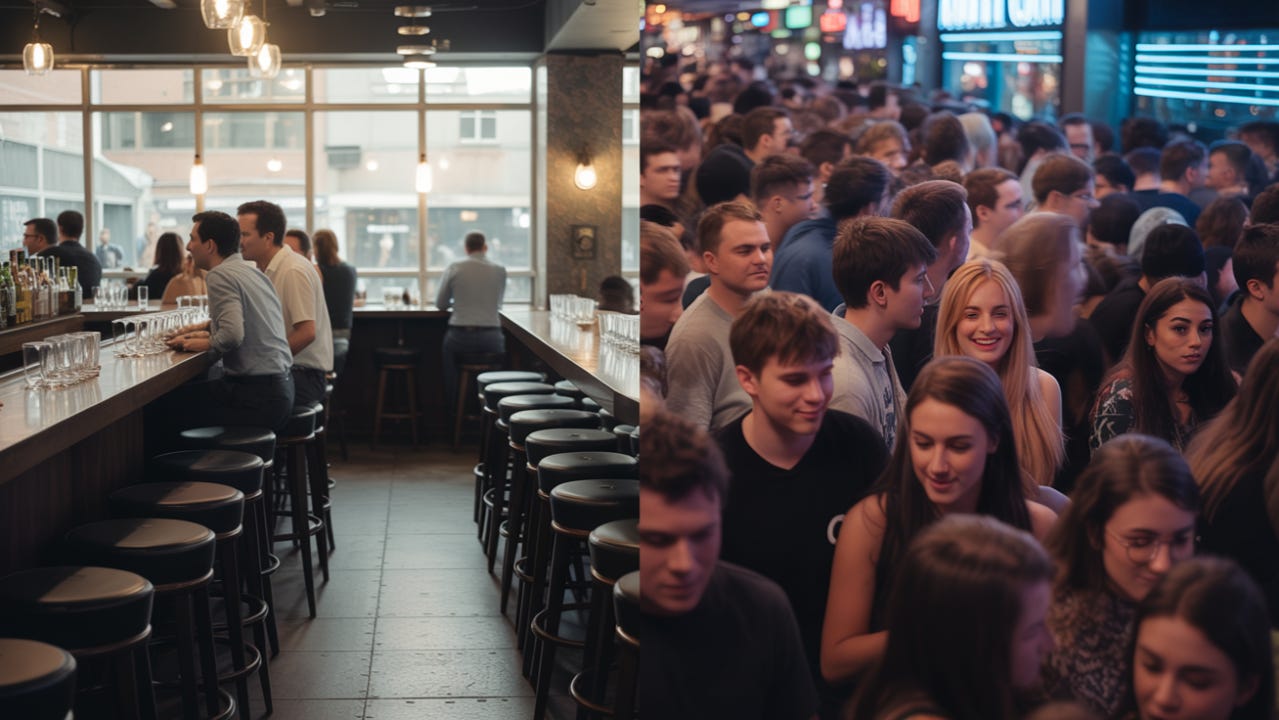
For the past two years, the beverage alcohol industry has converged on a familiar explanation for what is happening on-premise. Visits are holding up better than expected. Alcohol consumption per visit is down. Consumers are going out less often but spending more when they do. Holidays and big sports moments now carry an outsized share of annual volume, while casual midweek occasions continue to erode.
That story is broadly correct. It’s also fundamentally incomplete. Talk to anyone running a college bar in Madison or Baton Rouge, and they’ll tell you the aggregate data is missing something structural.
The mistake is continuing to treat “on-premise” as a single business. It no longer is. One segment has not followed that shift: college market bars and clubs. While much of adult on-premise has moved from frequency to occasion, college nightlife remains one of the densest frequency-based drinking systems in the U.S
The Broad On-Premise Reset
At an aggregate level, the data paints a consistent picture. CGA by NIQ’s global on-premise research shows that 83% of legal-drinking-age consumers visited an on-premise venue in the last three months, even as over a third say they are drinking less than a year ago — evidence of recomposition, not collapse
The role of the on-premise has not disappeared. It has changed.
For most adult consumers, drinking has shifted from habitual to episodic. The ritual did not vanish. It compressed.
College Bars Are Not a Smaller Version of Adult On-Premise
College bars and nightclubs do not operate under the same logic.
When this piece refers to “college bars,” it means late-night venues in college-centric markets where the majority of traffic is driven by enrolled 21- to 25-year-olds (as opposed to all bars that happen to serve young adults). Within that environment, demand behaves differently.
College nightlife remains frequency-based. Weekly cadence still matters. Thursday through Saturday patterns remain highly predictable. Demand follows academic calendars rather than holidays. Social life is still venue-centric, and bars remain disproportionately central to gathering, signaling, and group memory formation.
Most importantly, drinking in these environments is still shaped by peer norms, not individual optimization. The question is less “whether to go out” and more “where and with whom.” The venue is rarely the destination. The social outcome is. That’s the job college bars are actually doing.
Gen Z over-indexes significantly on on-premise engagement, accounting for 28% of visits despite being only 20% of the population (CGA by NIQ/Lumina Intelligence). This isn’t a niche market - it’s where the next generation’s drinking habits are being formed.
Price Sensitivity Works Differently in College Nightlife
College consumers are typically price constrained, but they are not price disciplined. Ask any operator: the same group that complains about an $8 cover will turn around and drop $30 on shots when someone gets a job offer or a relationship ends.
Entry price, perceived deals, and speed to intoxication matter. Provenance, storytelling, and long-term value matter far less. Complaints about prices coexist with surprisingly high per-night spend when social stakes are high.
This helps explain why on-premise spirits continue to outperform beer by value even as broader price mix has softened. Control-state reporting increasingly points to trading down and slower growth in higher-priced tiers overall. In college nightlife, however, spending is driven less by rational budgeting and more by peer reinforcement in the moment.
The result is a paradoxical environment. Vocal about cost, reliably transacting anyway when social stakes are high enough.
Cognitive Load Tolerance is Limited
Product performance inside college bars follows a simple rule: cognitive load must be near zero.
Winning formats are familiar, fast, and socially safe. Losing formats require you to explain yourself. Vodka-based mixed drinks, domestic premium beer, shots, and RTDs fit the winning profile. Wine, complex cocktails, and much of craft beer fall into the losing category.
The opposite holds true in high-end cocktail bars, where patrons actively seek high cognitive load: complex menus, intricate ingredients, and storytelling that reward discovery and slow appreciation. Different spaces, different jobs to be done.
This mirrors broader on-premise data. Spirits have gained share in bars and restaurants, driven by tequila, vodka, and whiskey, categories well suited to simple serves. RTDs continue to grow as consumers seek predictability and convenience.
In college nightlife, these dynamics are amplified. Supporting this, younger consumers are 54-60% more likely to choose premium drinks than those over 55 (CGA by NIQ 2025), while RTDs build momentum in nightlife settings, aligning with fast, socially safe formats like shots and vodka mixes.
Consider what happens when a craft brewery tries to introduce a new IPA in a college bar at 11 PM on a Thursday. The bartender doesn’t have time to explain it, the patron doesn’t want to risk ordering something unfamiliar, and the moment has already passed. The liquid might be superior, but the format is wrong for the job
The Trade Blind Spot
Given their structural importance, it is striking how little trade advocacy focuses on college bars and clubs.
In most of the on-premise, trade advocacy is the engine. Brand ambassadors build relationships with bartenders and bar managers. They conduct tastings, staff trainings, and educational trips. They get bartenders to think of a brand first when making recommendations. Research shows 9 in 10 bartenders recommend serves or brands on every shift, and over 80% of consumers trust those recommendations. The model works because bartenders function as the bridge between brand and consumer.
But trade advocacy is built for a different pace. It assumes bartenders have time to educate, not just recommend. It assumes recommendations happen through conversation and discovery. It assumes the venue rewards storytelling and consultation, not pure transaction speed.
As someone who leads brand partnerships at LineLeap, a platform operating in 700+ frequency-based nightlife venues, I’ve seen firsthand why traditional trade advocacy falls flat in college markets.
College bars don’t operate that way. Bartenders are making recommendations constantly, often to customers who genuinely don’t know what to order yet. But recommendations happen at transaction speed, not consultation speed. “What should I get?” needs an answer in three seconds, not three minutes.
The result is a disconnect. College bars represent one of the densest frequency-based drinking environments in the U.S., but traditional trade tactics don’t translate. Add extreme fragmentation, mostly independent operators, local regulation, and high turnover, and there is no obvious national body positioned to speak for the segment.
College bars are economically and behaviorally central, but the industry has no organized infrastructure to reach them at scale.
This is the gap that LineLeap was built to occupy.
With over 700 partner venues across 150+ markets including Nashville, New York, Chicago, Boston, and Los Angeles, LineLeap operates as transactional infrastructure for frequency-based nightlife. It standardizes entry, payments, ticketing, and drink ordering in environments where traditional trade advocacy can’t gain traction. While college-market venues represent the core of the platform, LineLeap operates wherever frequency-based nightlife exists. It doesn’t educate bartenders, host tastings, or build brand ambassadors. Instead, it provides the operational layer that makes this segment accessible to brands at scale.
Infrastructure fills the gap where advocacy can’t. In fast-paced, frequency-driven spots, tools that enable quick promotions, data on orders, and seamless payments win. It’s not that advocacy is dead or broken - it’s just mismatched here. Infrastructure is currently the best solution for brands to reach scale without relying on overworked bartenders for education.
The Real Reframe
The on-premise channel is not recovering evenly. It is polarizing.
Most adult on-premise has shifted toward concentration: fewer visits, higher stakes, more defensiveness. College nightlife remains one of the most concentrated frequency-based drinking systems in the U.S. These are different businesses. They reward different portfolios. They demand different thinking.
Right now, much of the industry is optimizing for the former while quietly overlooking one of the last environments where drinking habits are still being formed at scale. Which means when executives wonder why on-premise data doesn’t add up, they’re looking at two different businesses through the same lens.