
They’ll Find Us When They’re Ready
Spirits Brands Don't Want to Talk About Upstream Recruitment. They Should.


In 2009, Christopher Carpenter and Carlos Dobkin published a paper that should have embarrassed a lot of marketing departments. Using death records, they showed that mortality from alcohol-related causes spikes at age 21. A threshold is crossed and something activates.
The strategic question the data raises is where, exactly, that window opens. I’m not suggesting people suddenly start drinking at age 21. Many were already drinking. Legal access changes the quantity, the context, and the occasion in a way that’s measurable in mortality data.
College bars aggregate newly legal drinkers at a density that’s hard to replicate anywhere else. They’re also social environments, which matters for spirits specifically. Spirits in on-premise settings get ordered in rounds, built into cocktails, poured as shots at tables. The category benefits from the mechanics of group drinking in a way that a liquor store purchase or a six-pack in a dorm room does not.
According to a Spotify data analysis, music experienced at ages 13-16 for boys, 11-14 for girls, is the strongest predictor of adult music taste. A 2021 NBER working paper looked at how craft beer preferences formed among Millennials and found that local craft-beer availability when consumers reached legal buying age predicted their beer preferences later in life. What you drank in your early legal years left a mark on what you reached for at 30. The paper is about beer, not spirits, but it’s my take that the findings are transferable across categories.
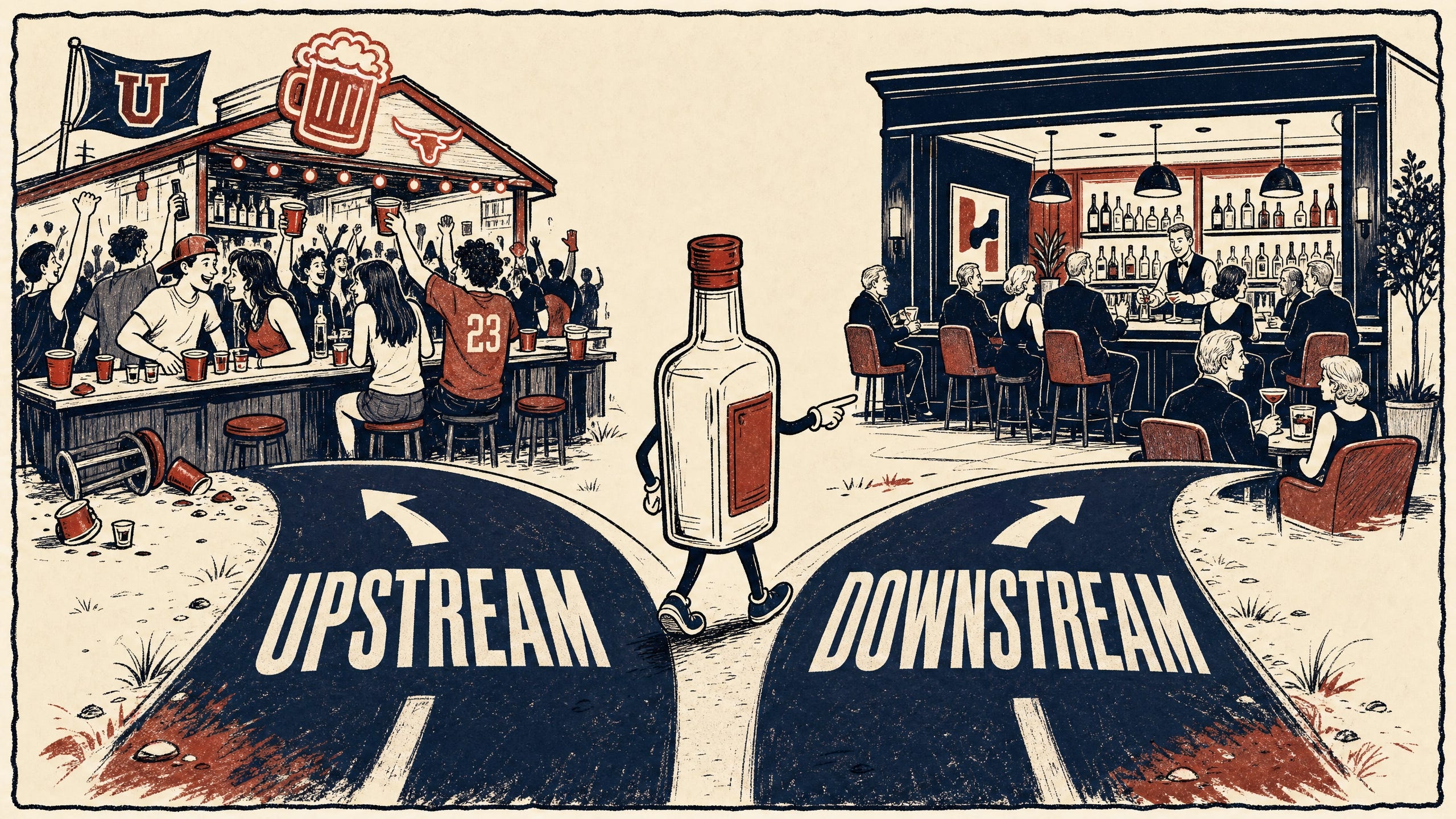
The spirits brands that have convinced themselves the college consumer isn’t worth prioritizing tend to run two arguments. The first is economic: the consumer has low discretionary income and the brand is premium. The math doesn’t work. The second is temporal: the consumer will grow into the category on their own. Taste develops, income grows, and premium spirits are there waiting on the other side of that arc. Just be present at the right moment further downstream, and the consumer will come to you. The NBER data says otherwise. The brand that’s waiting downstream is competing against whatever got there first.
A $14 cocktail and a $6 shot can contain the same liquid. The question is whether the brand has thought about how it shows up in an environment where the $14 version won’t move.
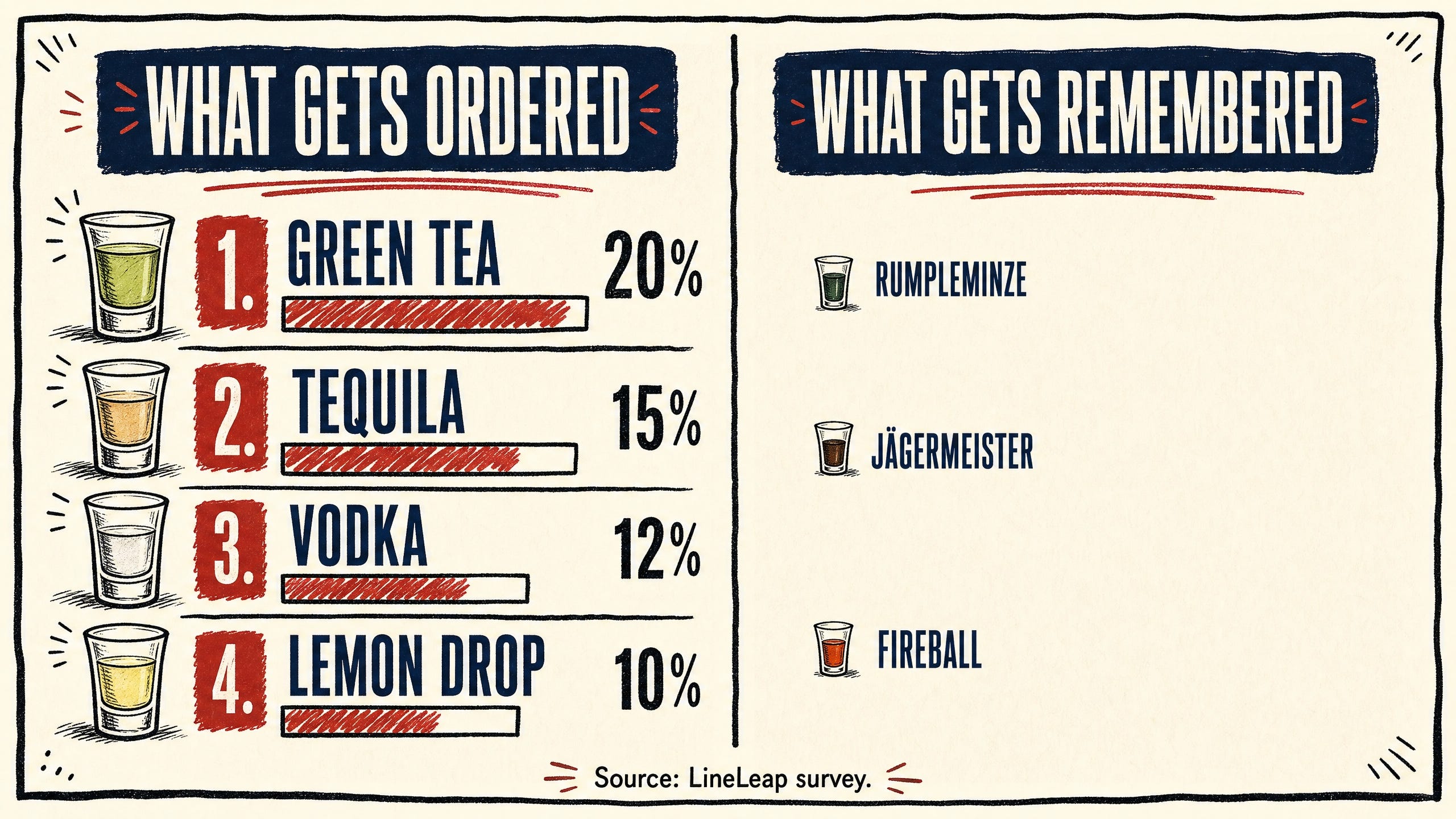
I spent time with Pete Sorrentino, one of the owners of Bullwinkle’s, a go-to bar in Lawrence serving KU LDA students. Green Tea is his top selling shot. Among the LineLeap audience, it was the most ordered shot at 20%. No brand owns it. Pete told me that the espresso martini shot, made with well spirits, also sells. Spirits brands have spent real money building the espresso martini as a cocktail occasion. The shot version of the same drink in a completely different environment, reaching a desired consumer at a price point that can be made to work. Nobody owns that either.
A LineLeap survey found that tequila and vodka together account for roughly a third of users’ favorite shots. No tequila brand showed up more than once in unaided recall. Tito’s was the only vodka named at any volume. Brand names don’t show up as part of the memory.
The growth of alcohol sponsorships in college sports is probably the industry’s half-answer to this problem. Get the brand in front of the consumer before the window opens legally, build some association, hope it carries through. It doesn’t, but it’s a rational bet. It’s also a different bet than being in the room at the moment when legal access actually changes behavior. The Carpenter and Dobkin data is about what happens at 21, not what happens at 19 in a basketball arena.
Age 21 is a threshold, not a window. Consumers cross it once. Most brands aren’t there when they do.