
College Bars Aren't the Exception. They're the Control Group
Part 2 of The New Occasion Architecture

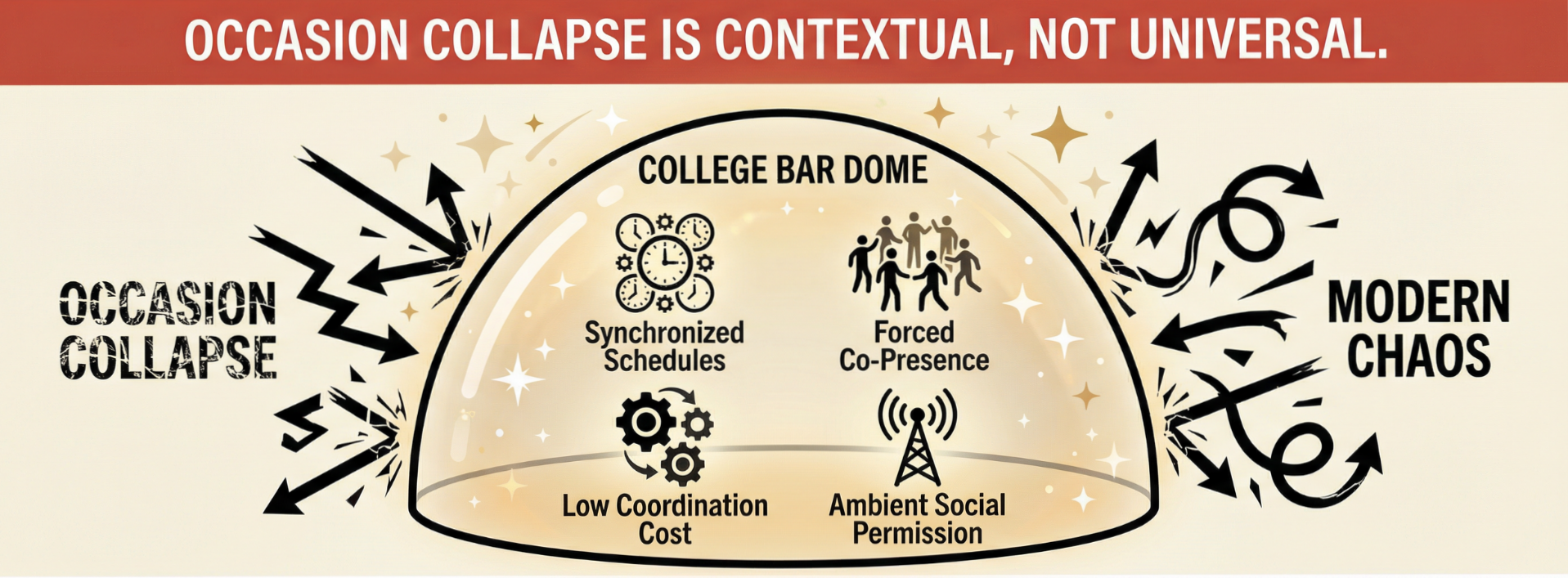
Last week, I laid out the three-layer framework reshaping on-premise alcohol: collapsed ambient occasions, fragile conditional occasions, and eventized occasions that concentrate rather than distribute.
More than a few people asked: What about college bars? They’re packed every night. Doesn’t that break your model?
Before answering, let’s briefly recap the Three-Layer Framework:
Layer 1: Collapsed Occasions
Ambient, habitual, automatic. The old base layer composed of weekday happy hours and "ending up out" without planning.
Layer 2: Residual Occasions
Conditional, mood-dependent, fragile. This layer splits: unprogrammed (collapsing—random Thursday nights, "maybe we'll go out") and programmed (stable—weekly NFL Sundays, recurring trivia nights that create structured frequency through ritual).
Layer 3: Eventized Occasions
Intentional, planned, high-stakes. These are the anchor moments people coordinate around - Super Bowl, birthday dinners, championship games. They require effort, but they're reliable. This is where the industry's attention has shifted
In that light, college bars do look exceptional. High frequency. High velocity. Predictable demand. Tuesday looks like Friday. September looks like April.
But calling them an outlier lets the industry off the hook.
A better question is whether college bars are simply the clearest surviving example of a system that still works. Not an exception to the rule. A control sample. The last place where the Layer 1 architecture of ambient drinking remains intact.
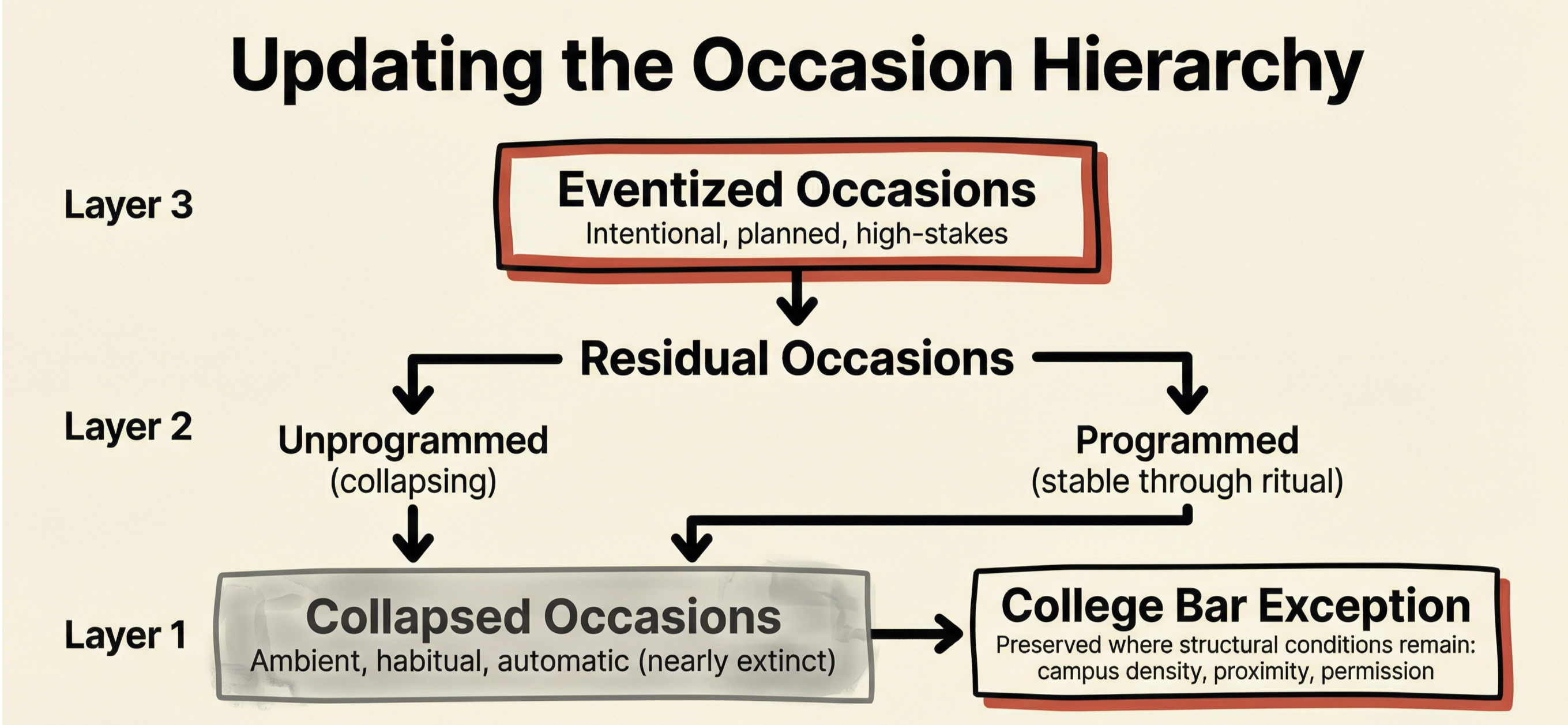
The distinction between outlier and preserved system matters.
If you treat college bars as an outlier, you conclude that on-premise frequency is dead, habit formation is impossible, and the only path forward is premium-only positioning. You accept the decline as consumer preference and build for a smaller, wealthier audience.
If you understand college bars as preserved systems, you see something different. Frequency isn’t gone - it’s architectural. Permission isn’t cultural - it’s structural. Alcohol lost the scaffolding that made frequent consumption easy. A much different conclusion than the idea that alcohol simply lost relevance.
And that reframing changes quite a bit:
How you think about programming: Is it possible to create conditions that produce repetition?
How you balance volume versus margin: Are you optimizing for the wrong metric?
How you interpret Gen Z behavior: Are they rejecting drinking, or are they just the first generation navigating adulthood without the infrastructure that used to support it?
What Makes a Drinking System Intact
Across decades of alcohol consumption, systems that reliably produced volume shared five structural conditions:
1. Temporal Synchronization - People are free at the same time. Classes end at similar hours. Weekends align. There’s a shared rhythm to the week.
2. Spatial Concentration - People are physically near one another. Campus housing. Greek life. Dense, overlapping social networks within walking distance.
3. Low Planning Cost - Participation requires minimal coordination. You don’t need three days of group chat negotiation. You just go. Someone’s already there.
4. Social Permission - Drinking is justified, expected, or rewarded. It’s woven into identity formation and bonding rituals. It has a job to do.
5. Repetition - The occasion recurs often enough to become habitual. Not just Friday. Not just special weekends. Multiple times per week, creating routine rather than novelty.
When all five exist, alcohol thrives without persuasion. When one breaks, frequency degrades. When two or more break, the occasion collapses. Jane Jacobs would recognize this immediately
College bars still satisfy all five. That makes them both unique and rare.
Is This About Age or Structure?
The industry loves demographic explanations. “Of course college bars are busy - it’s 21-year-olds.”
If age were the sole driver, behavior should vanish post-graduation. But that’s not what we observe.
Drinking doesn’t disappear post-college. It becomes episodic, planned, and fragmented.
Frequency drops because the system dissolves, not because desire vanishes.
The decline coincides with:
Desynchronized schedules (your Tuesday off is my busiest work day)
Geographic dispersion (your college friends live in seven different cities)
Higher coordination costs (the group chat that used to say “Murphy’s at 9” now requires a Doodle poll)
Competing obligations (kids, mortgages, early meetings)
Structure, not age, is the causal factor.
Other Systems That Still Work
College bars aren’t alone. A few other environments preserve the same architecture.
Military bases and deployment hubs recreate the system institutionally:
Fixed schedules (everyone gets off at similar times)
High social density (base housing, tight units)
Strong group identity (branch loyalty, rank-based rituals)
Alcohol as bonding mechanism (normalized, expected, part of decompression)
Base-adjacent bars show predictable weekly spikes, strong brand loyalty, and high repeat visitation. This isn’t youth-driven. This is institutionally synchronized adulthood.
Certain professions still preserve intact systems - restaurant workers, bartenders, live event crews, touring musicians. They share late-night schedules, ritualized post-shift drinking, and tight social circles. But they drink inside closed systems. The behavior doesn’t scale. It’s ambient drinking, but only for the 2% of the population whose lives still operate on the old schedule.
Resort towns and seasonal economies temporarily recreate these conditions, but only during peak season. Festivals and multi-day events create compressed intact systems, but they dissolve immediately afterward. They’re spikes, not systems.
What College Bars Are Actually Telling Us
College bars are not magical. They are structurally complete.
They represent rare environments where:
Time aligns (academic calendars synchronize schedules)
People cluster (housing and campus create unavoidable density)
Drinking solves coordination problems (the bar is where you find people)
Repetition is guaranteed (semester structure creates rhythm)
They are not an outlier in behavior. They are an outlier in design integrity.
Why the System Works
College bars absolutely compete with each other. Thursday at one bar dies when another bar launches a better theme night. But even the losing bar still has a floor. The slowest Tuesday at a mediocre college bar would be the busiest Tuesday most adult neighborhood bars will see all month.
The difference isn’t that college bars don’t have to work for it. It’s that they’re working with structural tailwinds instead of structural headwinds.
Compare that to a neighborhood bar trying to drive midweek traffic. They’re fighting desynchronized schedules, geographic sprawl, high coordination friction, ambiguous permission, and no repetition guarantee. All structural headwinds.
An Uncomfortable Truth
The beverage alcohol industry has spent five years blaming consumers:
Gen Z doesn’t drink
Health trends are killing us
GLP-1s are destroying volume
People are just more boring now
But college bars prove that when the system is intact, people still drink. Frequently. Predictably. Habitually.
Not because they’re ignoring health trends (college students are as wellness-conscious as anyone. Not because they’re immune to economic pressure. Because the architecture still works.
The lesson isn’t “target college students.” The lesson is: fix the system or accept that Layer 1 is gone for good.
Easier said than done.
Most adult environments now violate at least two of the five requirements:
Work is asynchronous (nobody’s off at the same time)
Social circles are diffuse (friends live in different cities)
Planning costs are high (coordination is a tax)
Permission is ambiguous (drinking has no clear cultural job)
Repetition is fragile (variance kills habit formation)
Alcohol cannot compensate for that loss on its own.
Where do we go from here?
College bars are not a special case. They are a control sample. They show what happens when the old architecture still exists.
But outside of college campuses, military bases, and a handful of niche professions, that architecture is gone. Layer 1, the ambient, habitual, frequent drinking of days gone by, no longer has the structural conditions it needs to survive at scale.
The industry can’t rebuild those conditions through better marketing or cheaper beer. You cannot advertise your way into temporal synchronization. You cannot promote your way into spatial density. You cannot discount your way into lower coordination costs.
The future of on-premise alcohol will not be decided by resurrecting Layer 1. It will be decided by how well operators and brands adapt to Layers 2 and 3.
Layer 2 (programmed occasions) still works when you give people a reason to synchronize: trivia nights, live music, watch parties, recurring themed events. The coordination cost is higher than Layer 1, but it’s manageable. The key is repetition and ritual - weekly anchors that reduce planning friction even when the broader system is fragmented.
Layer 3 (eventized occasions) works by concentrating demand into high-intensity moments: music festivals, destination weddings, milestone celebrations, marquee sporting events. These don’t produce frequency, but they produce intensity. The margin is different. The strategy is different. But the demand is real.
College bars will remain visible, profitable, and structurally complete. But they’re not the model for what comes next. They’re proof that the old model still works - when all five conditions align. More importantly, they’re a reminder that alcohol hasn’t lost relevance. It lost the structures that made frequent consumption easy.
The work now is building systems that function without the new occasion architecture.
This is the second installment in Proof Points' series on the new occasion architecture. The first piece, "The New Occasion Architecture," laid out the three-layer framework: collapsed ambient occasions, fragile residual occasions, and eventized occasions that concentrate rather than distribute.
This piece examined why college bars aren't an exception to that framework but a preserved system, the last environment where all five structural conditions for ambient drinking remain intact.
Next, I'll look at sports occasions, another category the industry treats as a monolith but which actually spans all three layers of the hierarchy, and why that distinction changes how brands and operators should be investing.