
The New Occasion Architecture
Understanding structural shifts in on-premise alcohol

Something feels broken in beverage alcohol. Bars are often dead on Tuesday. Happy hour is a coin flip. Frequency is down.
But Friday night? Packed. Saturday? Can’t get a table. Memorial Day weekend saw lines out the door. Fourth of July delivered some of the biggest on‑premise uplifts of the year.
The industry keeps treating these as contradictions. Walk into any conference and you’ll hear two simultaneous narratives: “The on-premise is dying” and “We just had our best weekend ever.” Both presented as fact. Neither acknowledged as compatible. These aren’t contradictions - they’re different signs of the same evolution.

My recent piece, “Summer’s Occasion Stack Is Real,” argued that drinking is concentrating into intentional, stacked moments rather than spreading evenly across the week. Since then, operator reports, Fox News coverage of shifting happy hour habits, and fresh CGA by NIQ data haven’t contradicted that thesis. They’ve sharpened it.
The Three-Layer Reality
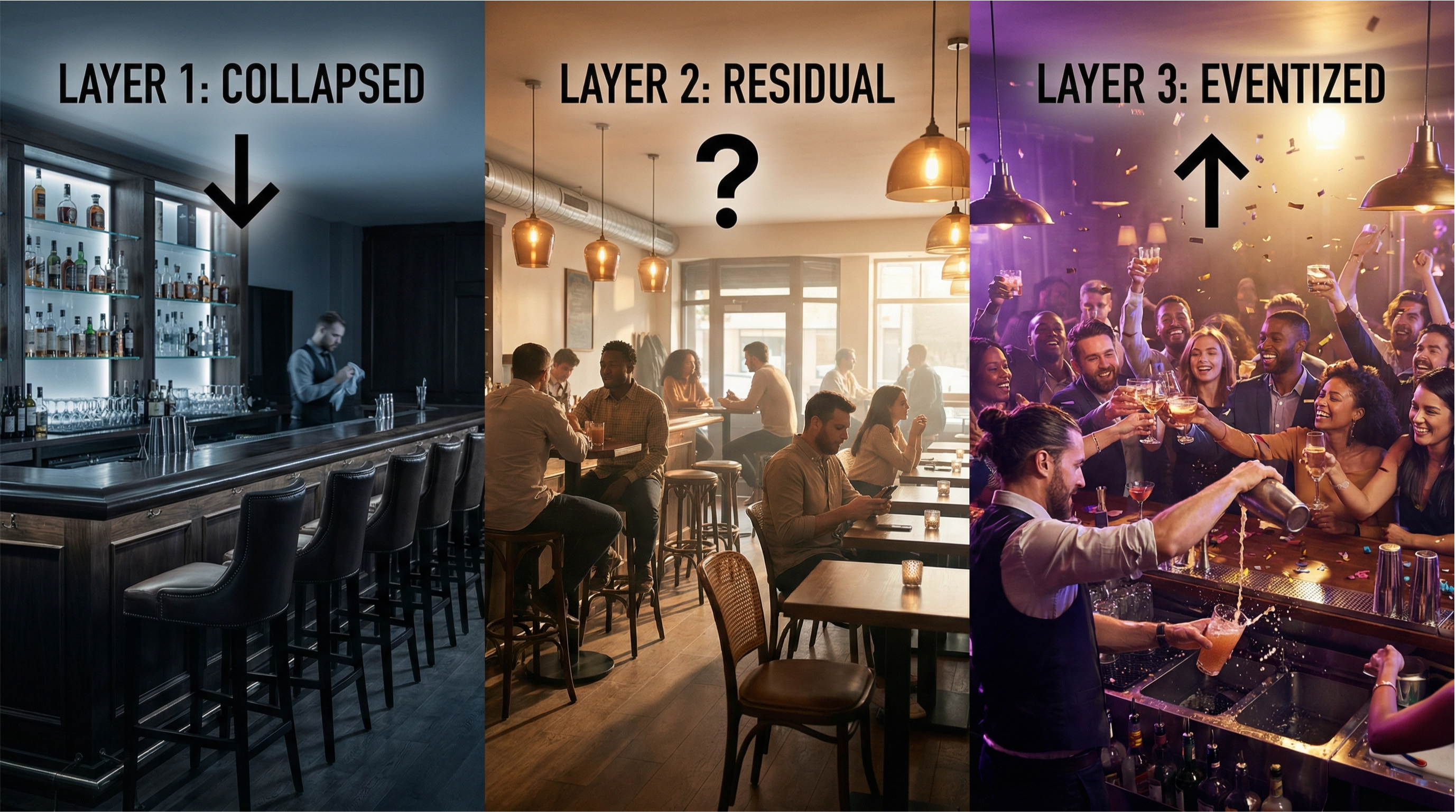
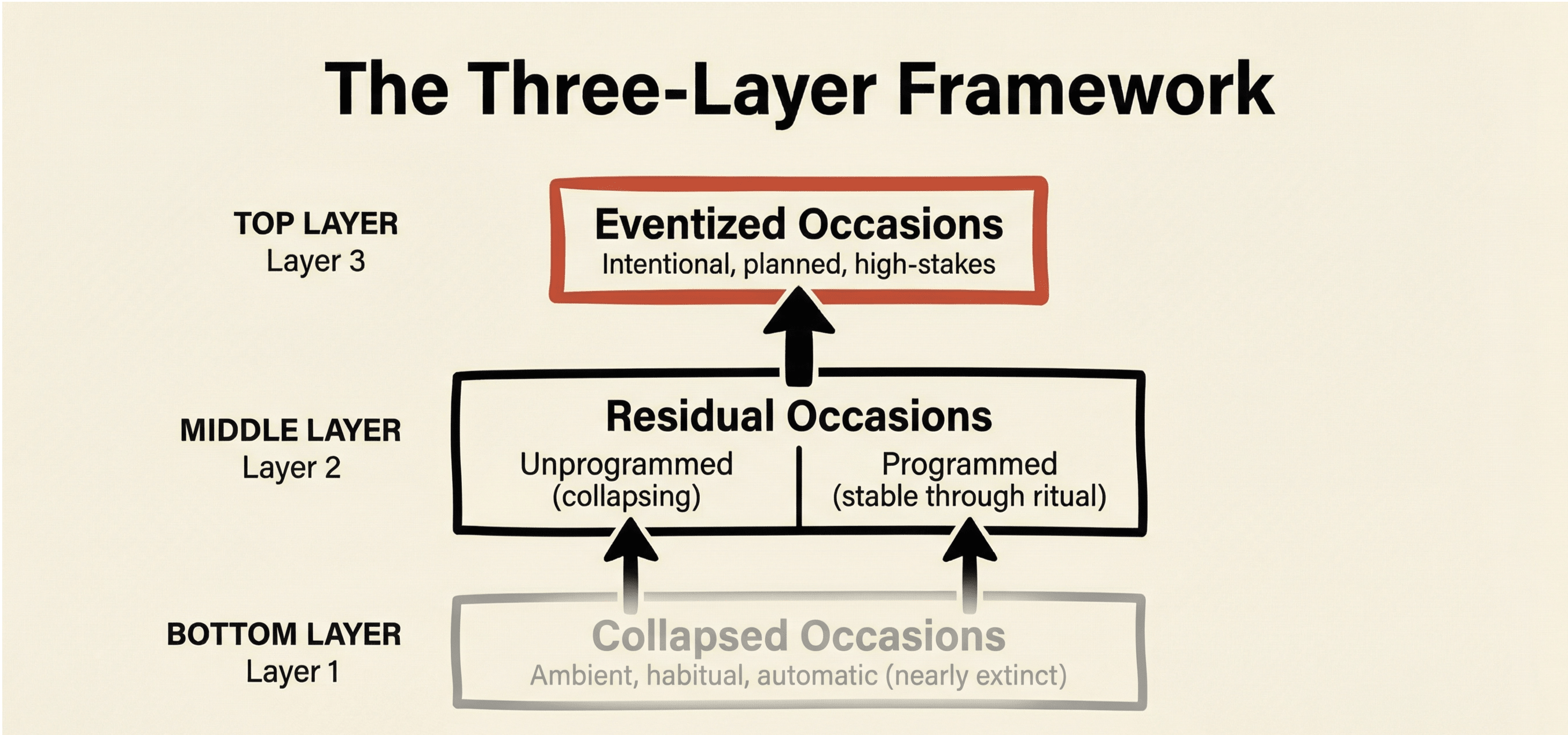
The on-premise isn’t dying uniformly. It’s reorganizing across three distinct layers:
Layer 1: Collapsed Occasions - The automatic, habitual drinking that used to power weekday volume
Layer 2: Residual Occasions - The unpredictable, conditional middle that creates false hope when not correctly understood
Layer 3: Eventized Occasions - The intentional, planned moments that concentrate and compress rather than distributing evenly across a period of time
Most industry confusion comes from failing to distinguish between these layers. Operators see Thursday pop one week and die the next, so they assume the market is “inconsistent.” It’s not inconsistent. In many markets, Thursday lives in Layer 2 now - the fragile middle where everything depends on whether conditions align.
The real action is understanding which layer each occasion lives in, and what that means for how you show up.
Layer 1: What Actually Collapsed
Let’s be precise about what died. It wasn’t “going out.” It was “ending up out.”
For decades, the backbone of alcohol volume was built on routine, not intention:
Automatic weekday happy hour
One drink before heading home
Unplanned bar stops driven by proximity
The 5-7pm office ritual that everyone just... did
These occasions worked because three structural inputs were reliably present:
Physical co-presence (people in the same place at the same time)
Predictable schedules (everyone got off work around the same time)
Alcohol as a friction reducer during transitions
All three have degraded. With hybrid and remote work penetration reaching 40–60% in knowledge work sectors, the structural foundation of weekday happy hour has eroded.
Remote and hybrid work removed the transitional moment alcohol historically occupied. When your workday ends at the kitchen table, there’s no commute, no office exodus, no “we’re all heading to Murphy’s, you coming?”
Fox News covered this shift in their December 2024 segment on post-pandemic bar culture, quoting New York operators describing fragmented happy hours, midweek softness, and the death of habitual after-work drinks.
No moral judgment. No generational scolding. It’s architectural. The occasions that required no coordination are disappearing.
The Data Confirms the Fragmentation
CGA by NIQ’s latest on-premise data shows this bifurcation clearly. In a recent US read, on-premise value was up about 4% year-on-year while ticket counts fell 2%, driven by roughly a 5% increase in spend per visit to around $57. Even as traffic softens in early 2026, US on-trade value is still climbing, which only happens when people are spending more on the occasions that survive.
CGA by NIQ’s on‑premise tracking in 2025 and early 2026 shows pressure on weekday visits even as big events and weekends keep value growing.
A nuanced view is needed. The “less drinking” headlines obscure the fact that we’re observing less ambient drinking and more concentrated drinking.
Layer 2: The Fragile Middle
This is the layer that fools everyone.
Layer 2 occasions still happen. They’re just unreliable. Conditional. Mood-dependent. Weather-sensitive:
Midweek dinners out (sometimes Thursday, rarely Wednesday)
Casual dining drinks (depends on the group, the budget, the vibe)
Unprogrammed social plans (”Let’s do something tonight?”)
Convenience-driven bar visits (the place you hit because it’s close)
These occasions are thinning. They fluctuate week to week. And they’re the source of most operator confusion.
Here’s why Layer 2 is dangerous: it creates false hope. An operator sees Thursday pick up for two weeks in a row and thinks, “We’re back, baby!” They staff up. They order inventory. Then Thursday dies for three straight weeks and they’re holding the bag.
When all the stars align, Layer 2 delivers. When they don’t, it ghosts you.
Wine Communications Group and bw166 reporting highlights this clearly: casual and mid-tier wine programs are getting crushed, while fine dining and destination accounts are holding. The middle isn’t stable.
You can’t build a business on maybe.
Rather than full-on collapse though, I see this layer spliting. Layer 2 occasions that get programmed into rituals can stabilize. Weekly NFL Sundays, monthly trivia nights, recurring happy hours with built-in social groups. These aren’t ambient. They require intentional structure, coordination, and consistency. But when you program them, Layer 2 can hold.
The key difference: programmed Layer 2 creates structured frequency through ritual, not ambient frequency through proximity. It’s event-engine logic applied to mid-tier occasions. Most bars don’t have the discipline or the density to pull this off, which is why Layer 2 keeps fragmenting. But it’s possible.
Layer 3: What’s Actually Strengthening
Meanwhile, eventized drinking is intensifying
Layer 3 occasions are:
Planned nights out (the group chat that starts at 2pm)
Destination bars (the place you Uber to, not stumble into)
Theme weekends (bachelorette parties, birthdays, wine bar crawls)
Seasonal rituals: sports playoffs, festivals, weddings, travel
Special occasions: anniversaries, promotions, that hard-to-get reservation
These occasions are fewer. But they’re heavier. They carry more narrative weight. They justify higher per-visit spend. They get documented, shared, and remembered.
Big days are getting bigger. When there’s a defined reason to go out, like the Kentucky Derby, roughly 7 in 10 consumers who plan to celebrate say they’ll do it in the on-premise.
What matters is that these occasions are curated, not casual.
You don’t just show up. You coordinate. You plan. You research. You check Instagram. You ask the group chat. You make a reservation. You dress accordingly. You budget for it. You build it up.
The mental investment is higher. The financial commitment is higher. The social stakes are higher.
This is why on-premise spend per visit has remained relatively resilient even as frequency drops. In US surveys, roughly three-quarters of adults say they’ve eaten out in the past month and about half say they’ve gone out for drinks, even in weeks when visit counts dip – the customer hasn't disappeared, casual occasions have.
CGA finds that even when some consumers cut back on how often they go out, a meaningful slice say they’ll “treat themselves” and trade up when they do – fewer nights, better nights.
This isn’t recovery. It’s selection. The occasions that survive are the ones worth showing up for.
The Psychology of Earned Permission
Here’s what the industry still doesn’t grasp: alcohol has moved from ambient permission to earned permission.
For fifty years, you could count on a baseline of automatic consumption. People drank because it was there, because it was easy, because everyone else was doing it. The default was yes. You needed a reason to say no.
That permission structure is gone, especially for younger and urban cohorts. Now the default is “stay home.” You need a reason to say yes.
This maps onto established behavioral patterns:
Peak-End Rule: People remember experiences based on their peak moment and how they ended, not duration - one amazing Friday night matters more than four mediocre Tuesday nights.
Effort Justification: We value things more when we work for them - a bar you coordinate to visit feels more meaningful than one you stumble into.
Choice Overload: When faced with too many low-stakes options, people choose nothing; when faced with one clear high-stakes option, people mobilize.
The old system optimized for frequency through low friction. The new system optimizes for salience through high justification.
So What Can You Actually Do About It?
Knowing the map helps. But maps don’t pour drinks. The question every operator is quietly asking, and no one at the conference is willing to answer out loud, is: what does this mean for how I run my bar on a Tuesday? On a Friday? On the night that could go either way?
The answer depends on which layer you’re fighting for. And here’s the thing most operators get wrong: they try to fight for all three at once. They discount to save Layer 1. They staff up for Layer 2. They throw events at Layer 3. The result is a bar that’s exhausting to run and impossible to position. You end up optimizing for ghosts. The Tuesday regulars who aren’t coming back, the Thursday crowd that might or might not show.
Stop doing that.
Layer 1 is gone. You can’t resurrect habitual drinking through a happy hour menu, not in 2026. The structural inputs that made it work, the commute, the office exodus, the social default, aren’t coming back. The most disciplined thing an operator can do is accept this and reallocate. The labor hours, the inventory, the mental energy you’re spending trying to save Tuesday nights? Redirect them.
Layer 2 branches off into two paths, and your strategy depends on which one you’re targeting.
Unprogrammed Layer 2 (the fragile middle) deserves attention, but not investment. It’s the layer of readiness, not planning. When the group chat fires at 2pm and someone says “let’s do something tonight,” your bar needs to already be the low-risk answer. That means being visibly alive. A story, a post, a regular who shows up reliably enough to signal that tonight is worth trying. It means micro-moments, not mega-events: a guest pour, a playlist shift, a single limited special that makes tonight feel slightly different without requiring anyone to coordinate around it. The neighborhood bar’s advantage here is its lowest-friction bet status. Protect that. Don’t compromise it by trying to turn every night into something.
Programmed Layer 2 (the stable middle) requires intentional structure and repetition. Weekly NFL Sundays. Monthly trivia nights. Recurring happy hours with built-in social groups. These aren’t ambient. They require coordination, consistency, and discipline. When you program them, Layer 2 can hold. Programmed Layer 2 creates structured frequency through ritual, not ambient frequency through proximity - that’s the key difference. It’s event-engine logic applied to mid-tier occasions. Most bars don’t have the density or the discipline to pull this off, which is why Layer 2 keeps fragmenting. But it’s possible.
Unprogrammed Layer 2 is low-investment, low-return capture. Programmed Layer 2 is high-investment, high-return construction. Pick one. Trying to do both dilutes your positioning.
Layer 3 is where you build. And this is where the neighborhood bar has a secret weapon most operators haven’t realized they’re sitting on: social density. A birthday at your bar isn’t a birthday at a random venue. It’s a birthday surrounded by people who already know the guest of honor. That’s Layer 3 fuel - earned, intentional, narratively heavy - that a destination bar has to manufacture from scratch. You already have it baked in.
The play is to own a ritual. Not an event series. A ritual - the thing people organize their year around. The annual. The monthly. The occasion that exists because your bar decided to make it exist, and kept showing up for it long enough that other people did too. Rituals are how you turn ambient presence into intentional destination. They’re how a neighborhood bar becomes a reason to say yes.
Beyond that, it’s about becoming specific. Layer 3 lives in “let’s go to [X],” never in “let’s just go out.” The bar that’s simply a bar loses. The one with a clear identity, the thing it’s known for, the reason it gets mentioned by name in the group chat, wins. This isn’t about being trendy. It’s about being memorable enough to be the answer when someone needs one.
And finally, lean into the math that the data is already telling you. Fewer visits, higher spend per occasion. That’s not a problem. It’s an alignment. Better cocktails. A food menu worth staying for. A reason to linger. The bar that wins Layer 3 isn’t trying to be cheap. It’s trying to make the fewer visits feel worth it: earned, not assumed.
Fewer Visits, Higher Stakes
The industry is measuring the wrong variable. It’s tracking frequency when the market has shifted to salience.
The market has shifted from frequency to salience.
Fewer outings ≠ less importance
Less volume ≠ less meaning
Less habit ≠ less willingness to spend
For many guests, alcohol is less often the reason people go out. It’s the justification once they’re already there.
This is a profound reversal. For decades, the logic was: “Let’s get a drink” meant “let’s go to a bar.” The drink was the anchor. The location was negotiable.
Now the logic is: “Let’s go to [specific place]” and drinks are part of the experience. The location is the anchor. The drinks are supporting cast. Experiences drive destination choice, and beverage follows.
That reversal breaks every traditional forecasting model. It breaks distributor assumptions about baseline demand. It breaks promotional playbooks built on “drive traffic with a discount.”
If the old system was about lowering friction, the new system is about raising stakes - making it worth saying yes to.
Earned, Not Assumed
Alcohol still matters to people. What’s disappearing is the ambient permission to drink without an occasion.
For fifty years, the industry could count on a baseline of automatic consumption. People drank because it was there. Because it was easy. Because it was what you did after work. The default was yes.
That permission structure is gone for many consumers, especially younger and urban cohorts. Now the default is “stay home.” Now you need a reason to go out. Now you need a reason to choose alcohol over the seventeen other things competing for attention, budget, and time.
Growth now comes from earned occasions, not assumed ones.
That’s the new operating architecture.
The three-layer framework isn’t a forecast. It’s a map of the territory as it exists right now, backed by CGA data showing fewer visits, higher spend per occasion, and value concentrating into fewer, bigger days. Layer 1 collapsed. Layer 2 is fragmenting. Layer 3 is where the future lives.
Both things are true. Occasions have collapsed and occasions have stacked.
Which layer are you building for?