
Should Alcohol Be Paying Attention to Dirty Soda?
A proven consumer behavior, a narrow window, and real reasons it could fail

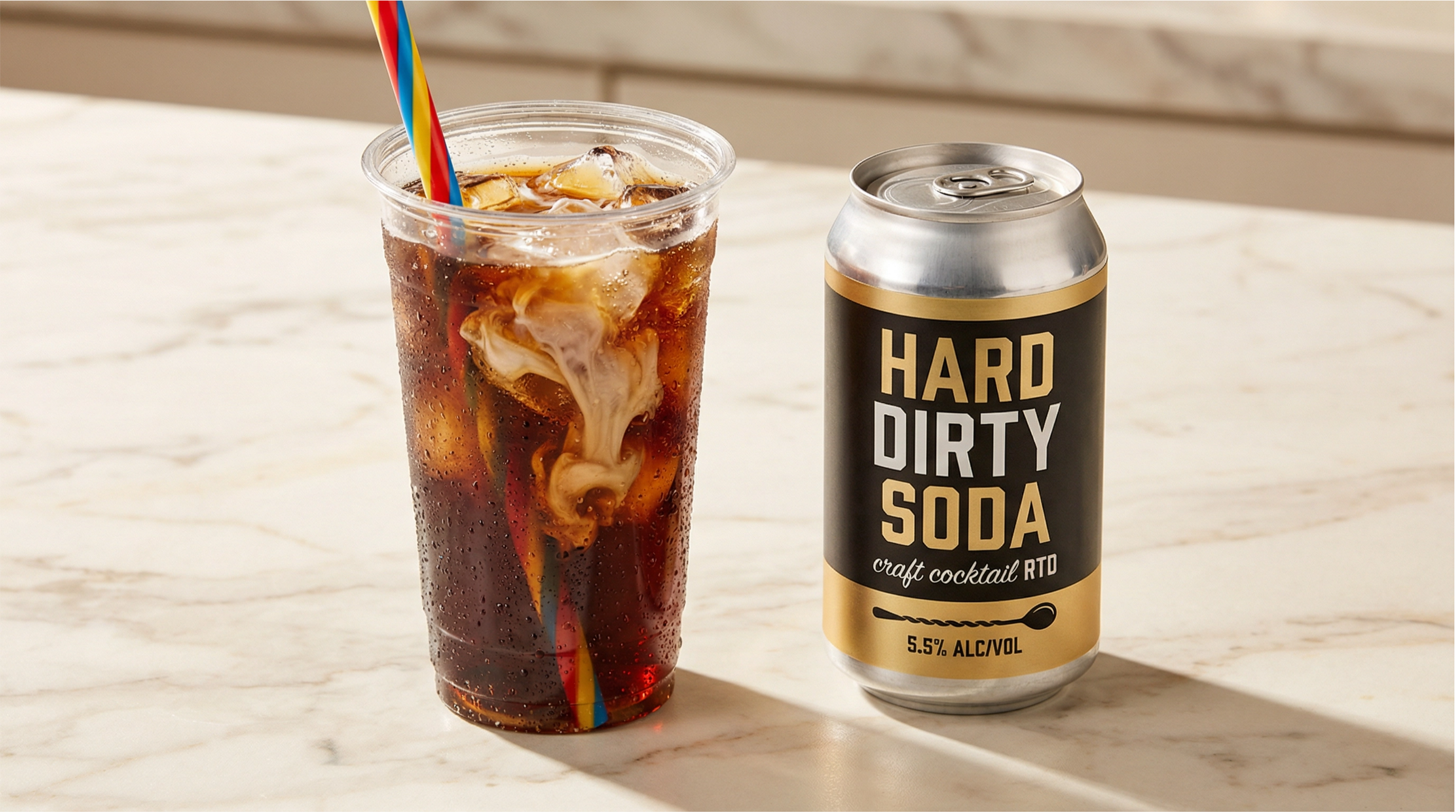
There’s a $50 million+ opportunity sitting in plain sight.
Non-alcoholic dirty soda, the syrup-and-cream-spiked fountain drinks that started in Utah and exploded across TikTok, has already done the hard work. Swig has over 50 locations and attracted private equity money. Taco Bell successfully tested its own line. The #DirtySoda hashtag has over a billion views, with consumers obsessively sharing their custom combinations like they’re mixologists.
The consumer behavior exists at scale. The ritual is established. The only thing missing is the alcohol.
What’s proven is the ritual and the appetite for customization and indulgence. What isn’t yet proven is whether alcohol can translate into that ritual without breaking it. That translation risk is real, but this is precisely what makes the window both temporary and valuable.
This is a unique moment when a proven behavior in an adjacent category creates a temporary, exploitable window for alcohol. But if the hard seltzer boom taught us anything, it’s that these windows close fast and brutally. The question isn’t whether alcoholic dirty soda (aka dirty-dirty soda) will exist. It’s who will get there first.
The Hard Seltzer Proxy
We’ve seen this play out before. In 2016-2017, La Croix and Spindrift weren’t just selling flavored sparkling water; they were normalizing a new drinking ritual. By the time White Claw launched, the consumer behavior was already validated at massive scale. Millions of Americans had been trained to reach for a flavored, bubbly alternative to traditional drinks.
White Claw and Truly didn’t create the demand. They added alcohol to an exploding category. The hard seltzer boom wasn’t innovation in the traditional sense; it was identifying and capitalizing on a new consumer ritual. The brands that moved fastest captured billions in value before the category flooded. Dirty soda is in that exact same position right now.
There’s an important difference worth acknowledging. Flavored sparkling water scaled because it was shelf-stable, sessionable, and operationally simple; dirty soda carries real formulation and cold-chain friction. That friction raises the execution bar, but it also narrows the field of who can credibly compete.
The Contrarian Case: Why This is Actually a Terrible Idea
Before I make the case for action, let’s be honest about why this could be a disaster.
The alcohol industry is in what is likely structural, long-term volume decline. Every new product is fighting for a smaller total pie, and retailers are cutting SKUs, not adding them. Products need velocity to survive shelf space scrutiny, but dirty-dirty soda is inherently occasional. It’s a treat, not a go-to. How does a high-indulgence, low-frequency product achieve the turns that retailers demand?
The real question isn’t whether dirty-dirty soda can forever be an everyday SKU. It’s whether it can prove exceptional launch velocity quickly enough to earn protection, expansion, or adjacency. This is a first-90-days test.
And yes, I’m aware that there’s a deeper irony here too. Dirty soda is succeeding precisely because it’s non-alcoholic. The trend came from Utah’s Mormon community (i.e., people who don’t drink). Adding alcohol might destroy exactly what makes it appealing. You’d be taking something that works as a Coke alternative and trying to make it compete with cocktails.
Dirty soda scaled because it occupied a safe, customizable, indulgent space that didn’t require social justification. Categories fail when they assume cultural proximity guarantees cultural permission.
And cream-based RTDs have real technical challenges: shelf life, refrigeration requirements, separation issues. These aren’t trivial problems. But they could also be a competitive moat. If a player like Diageo or Gallo solves it first, that’s IP-protected advantage.
Finally, there’s no clear price point. Ten to fifteen dollars for a four-pack? That’s too expensive to be sessionable, too cheap to signal premium quality. It’s stuck in exactly the middle that’s collapsing across the industry.
Multi-packs are likely the wrong format for this category. I think dirty-dirty soda makes more sense as a single-serve, cold-box, grab-and-go purchase, where a $3–$4 price point feels like a treat rather than a commitment. Format, not price alone, determines whether this works.
Why It Could Work: The Problems Are the Competitive Moat
And yet, I think the opportunity is real. Precisely because of those headwinds, not despite them.
Because volume is in structural decline, brands are desperate for new occasions and new consumers. This isn’t about stealing share from existing categories. It’s about recruiting people who are choosing dirty soda instead of alcohol right now. The target isn’t White Claw drinkers; it’s Swig customers who currently don’t have an alcoholic option. That’s additive, not substitutional.
Because velocity matters, products that prove fast initial turns get protected. A treat-based product with extreme differentiation and strong early demand can demonstrate the velocity that justifies shelf space. The key is that it’s not trying to be everyday. It’s trying to be irresistible when chosen. High dollar-per-unit velocity, not high unit velocity.
Because younger consumers drink less frequently, occasion-based products win. Dirty-dirty soda is inherently occasional. It’s not competing for Tuesday night six-packs; it’s competing for Friday night treats for those not frequenting the on-premise.
The non-alc category continues to grow, but there’s a gap between “I don’t drink” and “I drink regularly.” Dirty-dirty soda could recruit sober-curious consumers back into alcohol for specific occasions. People who’ve left spirits entirely but might try an alcoholic version of something they already love - a beverage that offers situational, permission-based alcohol. Dirty-dirty soda functions less as a gateway and more as a controlled re-entry point.
In a world of price compression and promotional hell, products that command premium pricing through experiential differentiation survive. A three-to-four-dollar single-serve dirty-dirty soda RTD isn’t competing on price; it’s competing on experience. That might have better unit economics than trying to out-value hard seltzer in the race to the bottom.
The Timing Imperative
Even if you accept that the opportunity is real, hard seltzer offers a brutal lesson. In 2018-2019, there was a brief window when the core behavior was proven, but the category wasn’t yet saturated. White Claw and Truly captured that moment. By the time the giants fully mobilized, when Bud Light Seltzer, Corona Seltzer, and dozens of others flooded shelves in 2020-2021, the first movers had already established dominant positions and the window had slammed shut.
The dirty-dirty soda window is open right now, but it won’t stay that way. The moment a major player announces a launch, every spirits company with an RTD platform will scramble to respond.
Who Could Actually Win Here
This isn’t just a thought experiment. If the opportunity is real, someone will capture it. Based on the capability requirements, here are the players who could actually execute:
Existing RTD brand extensions like Jack Daniel’s RTDs or Malibu could launch “Jack & Dirty Coke” as a line extension with immediate distributor acceptance and existing retail relationships. Cream liqueur brands like RumChata and Baileys have already solved shelf stability and cream-based flavor profiles, making RTD formats a natural adjacency. Let’s not forget that it was Gallo who saw the opportunity in Spirits-based RTDs with High Noon.
It’s also possible the first real signal doesn’t come from a major at all. A regional, refrigerated, or DTC-native player could validate demand and velocity before large suppliers mobilize. History suggests the winner may not be first, but the proof often is.
We’re in a stage that rewards speed and conviction. The cultural work has been done. The consumer education has been completed at someone else’s expense. The behavior is validated. All that remains is execution.
Yes, this is a category bet. But unlike most alcohol launches, the behavior isn’t speculative. The bet isn’t whether people want dirty soda. They do. The ritual is forming with or without alcohol. The only decision left is whether alcohol participates - or watches another category grow up without it.
The single-serve cold-box format point is sharp. Trying to compete in multi-pack velocity with a treat product seems like a category mistake from the start. The hard seltzer parallel is instructive but I think the cold-chain requirement here actually creates a diferent kind of moat, forces plyers into on-premise or specialty retail first which might be better for margin protection anyway.
Your point around the 90-day test window is also an interesting challenge...what 90 day window would you try to launch in to have a successful kickoff? The summer time could make sense, but historically isn't when BevAlc cream brands (like RumChata or Bailey's) see most of their consumption. If you look at an OND launch when BevAlc cream liqueurs have typically seen the majority of their volume, your running into issues around getting your product on the shelf (all major retailer have set what brands their going to carry through the end of the year, distributors aren't taking on new brands, etc). A bigger supplier might be able to overcome some of those hurdles....I don't have a definitive answer to this, there's pros & cons to whatever time period you choice to launch in.