
The Bar Is the Medium. The Medium Is the Message.
What Marshall McLuhan understood about drinking that the alcohol industry still doesn’t

“The medium is what happens to you, and that is the message.”
Marshall McLuhan, 1966
As far as I can tell, Marshall McLuhan never wrote about bars. He wrote about television, radio, electric light, and the phonetic alphabet. But buried inside his framework is as precise an explanation for what’s happening to on-premise than anything produced by the three-tier system in the last decade.
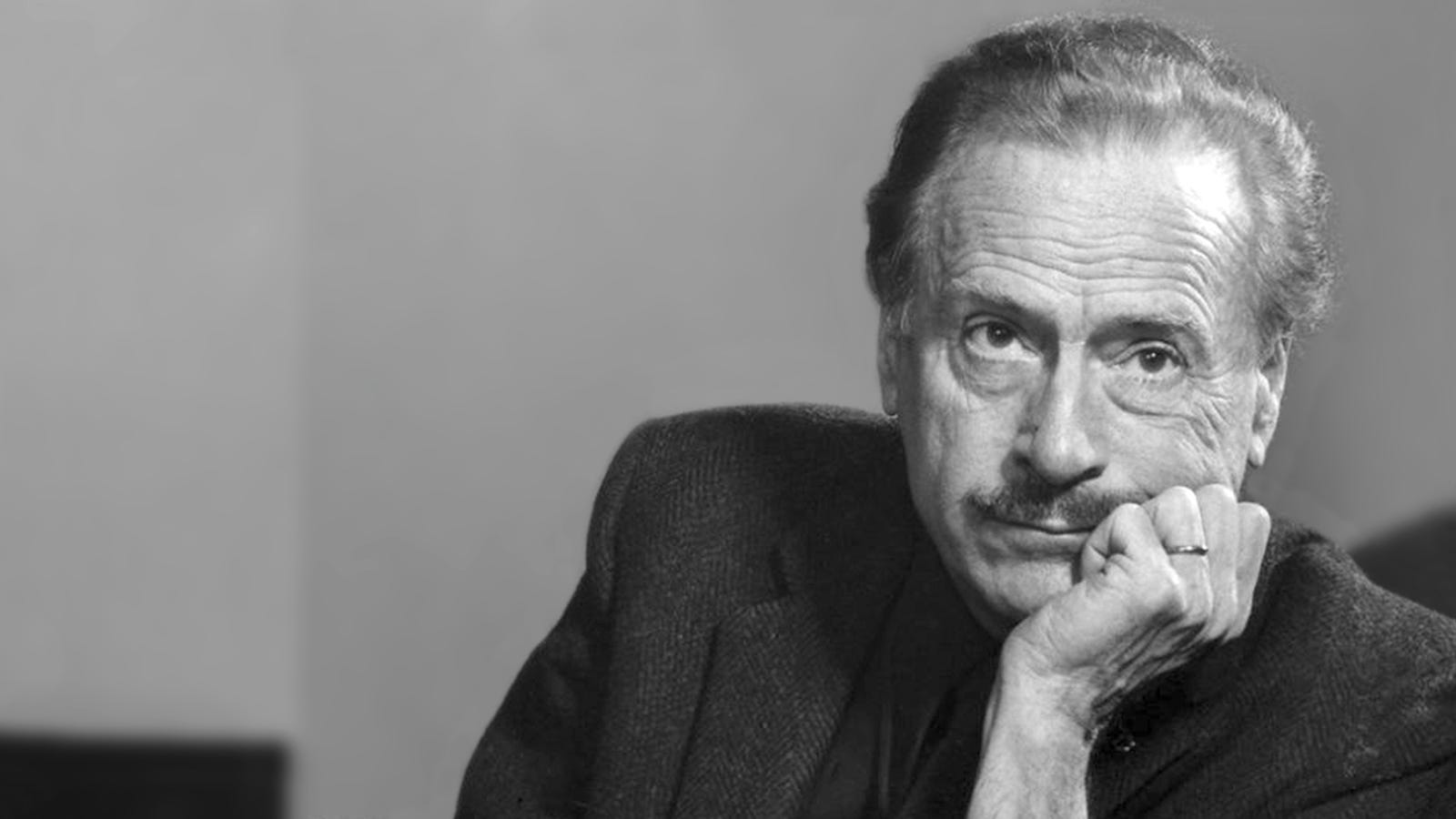
The insight is simple, and it’s a phrase everyone misremembers. The medium is the message. Not the drink. Not the occasion. Not the brand. The medium.
McLuhan meant that the form of a communication technology shapes human behavior more the content it carries. Television didn’t matter because of what was on television. It mattered because of what it did to the human nervous system, to family arrangement, to the rhythm of evenings. The content was incidental. The medium was the intervention.
Translate that to beverage alcohol, and the bar was never primarily about the drink. It was about what the bar did as a medium: it synchronized large numbers of people in physical space on a predictable schedule, lowered the planning cost of social contact to near zero, granted social permission for behavior that required explicit negotiation everywhere else, and made the accidental encounter structurally inevitable. The drink was the content. The bar was the medium. And the medium was the message.
This is why so much of the industry’s diagnostic work has been wrong. The category has spent enormous energy interrogating the content, the what-people-are-drinking question, while the medium itself has been coming apart. Tracking spirits share versus beer share, or seltzers versus RTDs, is the equivalent of debating network programming while the television set disappears from the living room. A more important question is not which content is winning inside the channel, but whether the channel is still capable of producing the social behavior the category depends on.
Hot and Cool
Another useful McLuhan concept is the distinction between hot and cool media. A hot medium is high definition. It delivers information with clarity and completeness, leaving little for the audience to fill in. A cool medium is low definition. It requires participation; the audience completes the experience through their own engagement.
Film is hot. The telephone is cool. A photograph is hot. A cartoon is cool. The higher the resolution, the less the audience has to do, and therefore the less they are implicated in the experience.
On-premise occasions map onto this axis with uncomfortable precision.
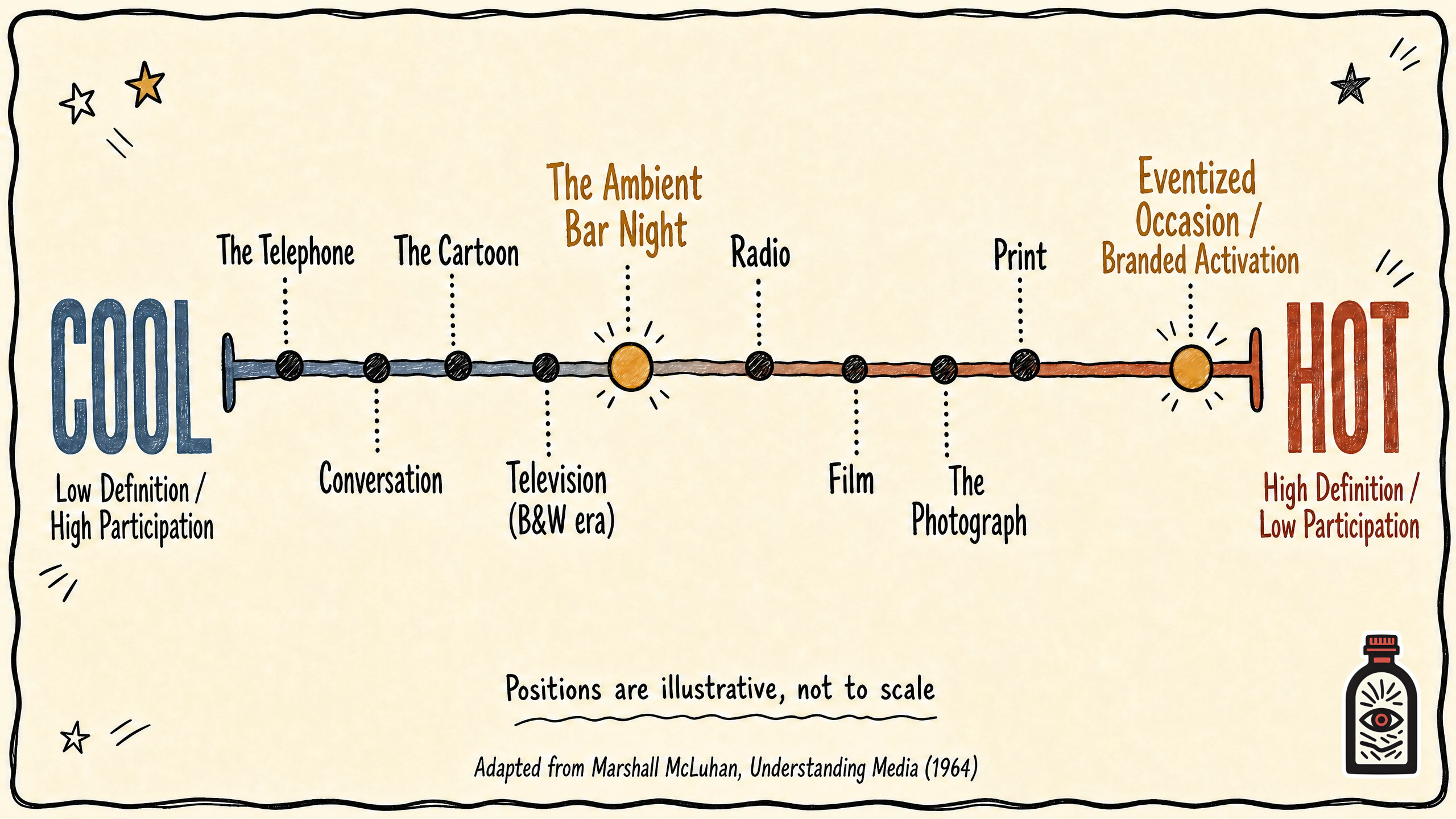
The ambient bar night is a cool medium. It’s low resolution. You don’t know who you’ll talk to, what will happen, or what the evening will become. The incompleteness is the point. Because you have to participate in constructing the experience, you are more deeply embedded in it. The social bonds formed in low-resolution environments are stronger because they required something from you. The accidental conversation, the stranger who becomes a regular, the night that became a story: these are functions of a cool medium operating normally.
The eventized occasion is a hot medium. It delivers high-definition experience: curated playlist, branded activation, bottle service with sparklers, a specific start and end time. Everything is resolved in advance. The guest doesn’t have to fill in anything. And the social outcome reflects that. People attend together, experience together, and leave together, their pre-existing relationships confirmed and their network unchanged.
The industry has spent fifteen years building hotter and hotter media while wondering why the emotional resonance keeps declining. The answer is in McLuhan. You can’t manufacture belonging through high-definition delivery. It requires participation.
The reason low-resolution environments produce stronger attachment is that people partially create the experience themselves. Participation creates ownership. Ownership creates memory. Memory creates attachment.
The Village That Wasn’t
In 1962, McLuhan predicted that electronic media would compress the world into a “global village,” restoring the tight social bonds of pre-industrial community through the intimacy of broadcast connection. He was right about the compression and wrong about the village.
What digital connectivity actually produced was hyperconnected isolation. Everyone accessible, no one present. Weak ties multiplied and ambient bonds collapsed. The infrastructure that had once generated community by accident, by proximity, by repetition, did not migrate to digital formats. It evaporated.
The alcohol industry absorbed this as a distribution problem. If people aren’t in bars, reach them through e-commerce. If they’re drinking at home, build DTC. If they’re on their phones, buy mobile impressions. The medium shift was treated as a logistics challenge rather than a structural rupture.
McLuhan’s framework suggests the rupture is categorical, not solvable by finding new pipes. The bar worked as a social technology because it was a cool medium that required human physical participation to function. No digital format replicates that. A Discord server is not a bar. An Instagram activation is not a bar. A virtual happy hour was, briefly, a category-defining example of a cool medium’s failure to survive format translation.
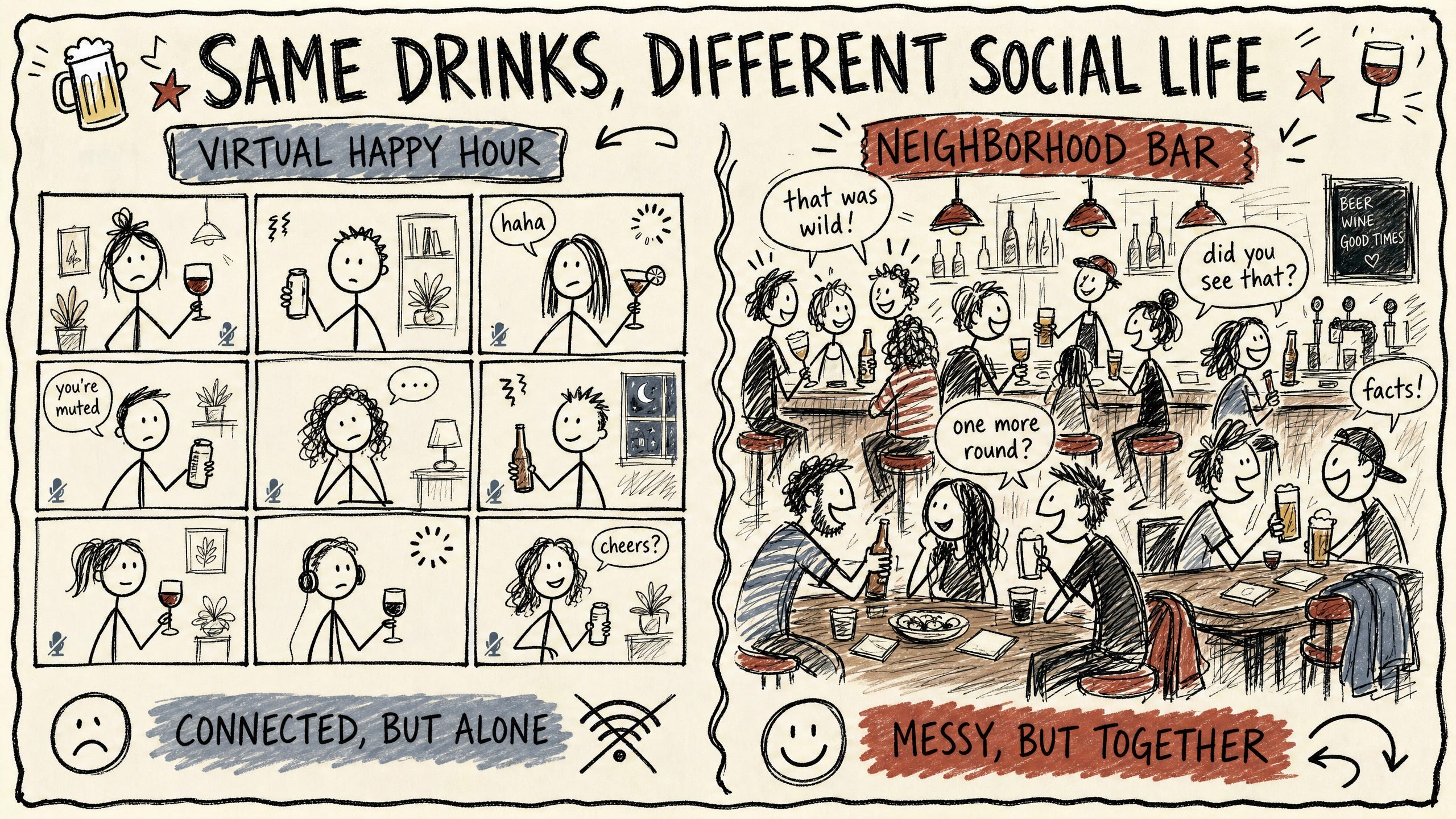
Digital mediums reorganized attention, scheduling, and social permission around the bar. They did not replace it. That means the problem is not only where drinking happens, but when and how social life gets synchronized in the first place.
What This Means for Beverage Alcohol
If the bar is a medium and the medium is degrading, the question for alcohol suppliers isn’t what content to put through a failing pipe. It’s what the next medium looks like, and whether it’s possible to attach to one.
This reframes several problems at once.
It reframes the occasion architecture conversation. The collapse of ambient occasions isn’t a preference shift. It’s a medium going offline. The Five Conditions I’ve written about here before, temporal synchronization, spatial concentration, low planning cost, social permission, and repetition, are, in McLuhan’s terms, the technical specifications of the bar as a medium. Remove any one of them and the medium stops transmitting.
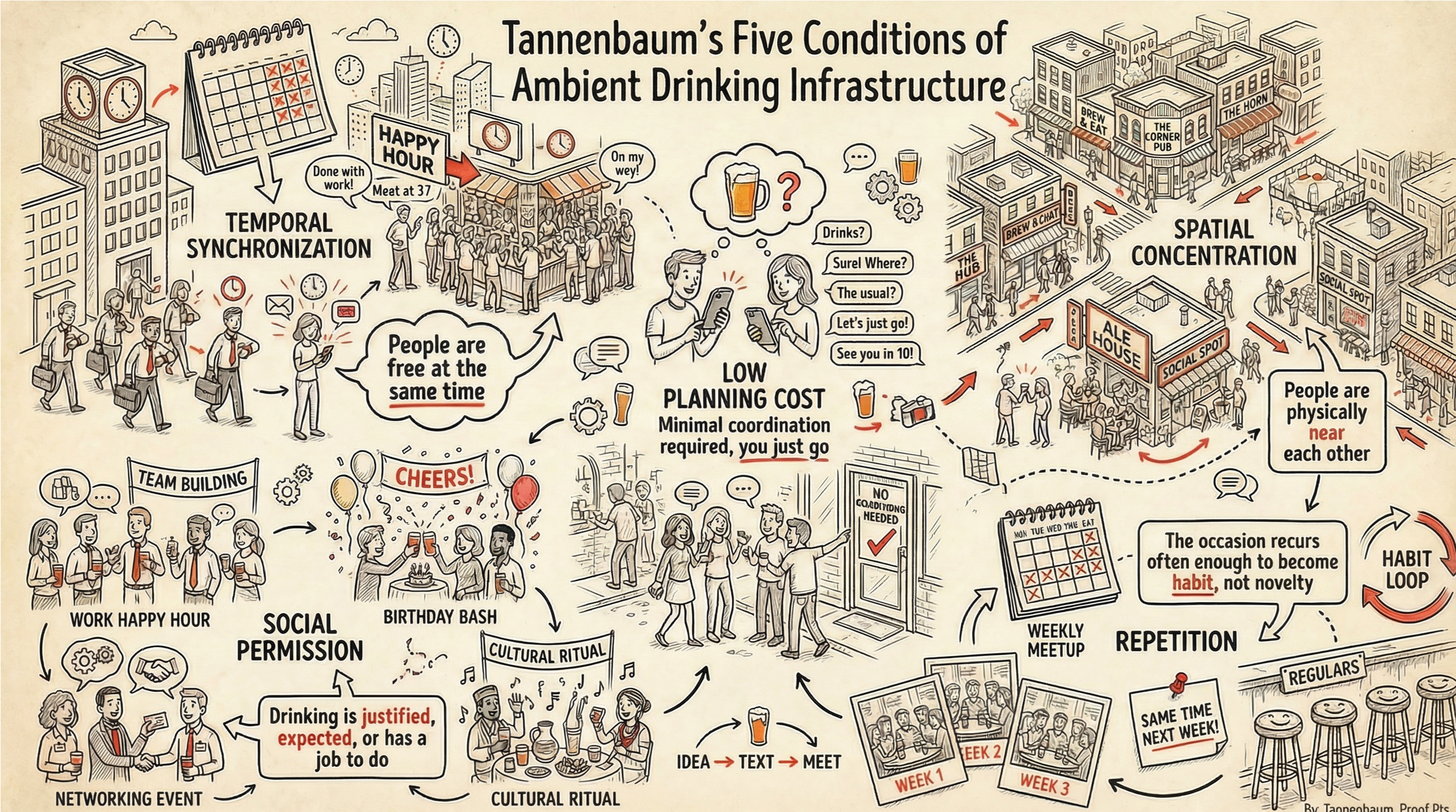
That is why “more occasions” is not the same thing as “healthier occasions.” A venue can be busy and still fail as a medium if the conditions that create participation have eroded.
It reframes the brand relevance question. If the medium is the message, then the brands most associated with cool media occasions carry cultural weight that high-definition activations cannot replicate. Being the beer of the Tuesday night regular carries more social meaning than being the official spirit of a stadium experience, even if the stadium numbers are larger. One is content in a cool medium. The other is content in a hot one. The first implicates the consumer in the experience. The second delivers to them.
It reframes the on-premise investment question. Suppliers who treat on-premise as a small sampling channel or a velocity metric because it’s less than 10% of their sales are using hot-media logic: deliver the content, measure the output. Suppliers who treat on-premise as the medium itself, and invest accordingly in the conditions that keep it functioning, are seeing the operating system, not just the apps running on top of it.
The bar that stays open, stays affordable, stays embedded in neighborhood rhythms, is preserving a transmission infrastructure that cannot be rebuilt once it’s gone. I made a version of this argument in “The Illusion of Stabilization” and the underlying logic holds here: the numbers that look stable are masking a structural condition that isn’t.
McLuhan died in 1980, before smartphones, before Uber, before the night out became a planning event rather than a default. But his framework holds. What the industry is watching is not a consumer preference shift. It is a medium going dark. And unlike content, media don’t come back once the infrastructure that carried them is gone.